Rice Bran as an SPF Booster: Vizor's NS SolaRYZE Adds 10 Units at 1%
Sunscreen is the most constrained category in cosmetics. To hit a labeled SPF, formulators must load enough active filter (zinc oxide, titanium dioxide, oxybenzone, octinoxate) — and that load drives white cast, heavy texture, and allergy risk. At in-cosmetics Global 2026 in Paris (April 14–16), Vizor introduced NS SolaRYZE, a new variable in this trade-off.
What NS SolaRYZE is
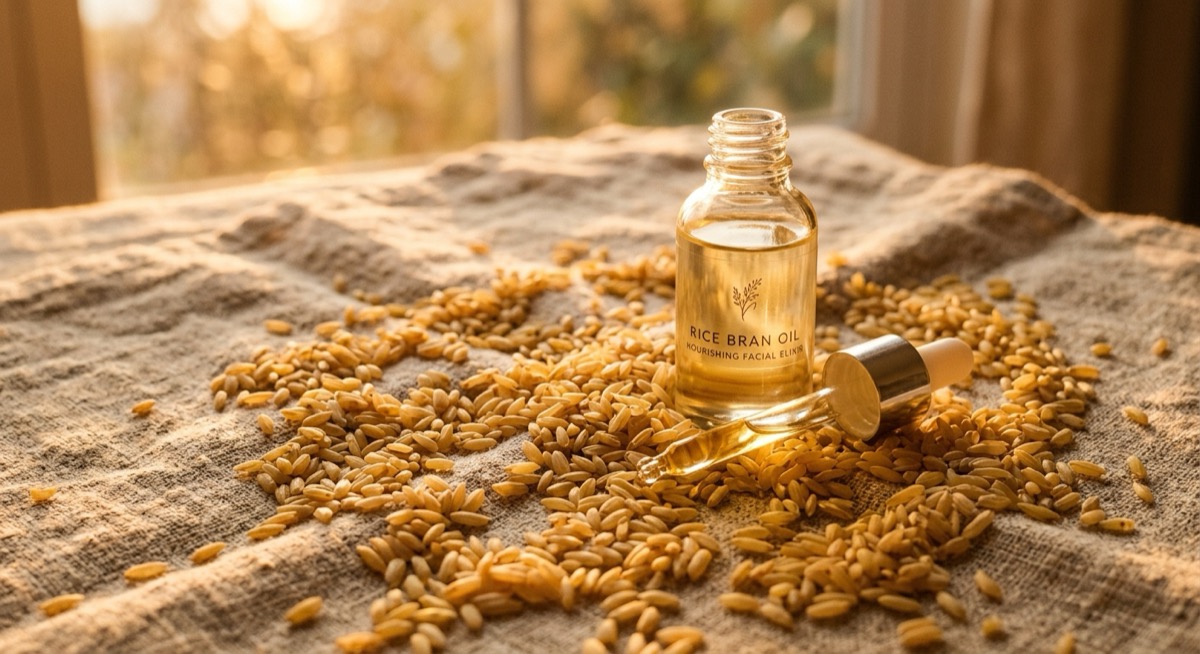
Vizor’s new ingredient NS SolaRYZE is an SPF booster based on organic rice bran extract. According to the company, at 1% use level it adds 10 SPF units when paired with zinc oxide or titanium dioxide.
In other words, a formulation rated SPF 30 can reach SPF 40 by adding 1% NS SolaRYZE. The point is to lift protection without adding more active filter.
The SPF booster category
SPF boosters do not directly absorb UV. They improve the efficiency of UV-active ingredients in three main ways.
First, by enhancing light scattering. Adjusting the matrix’s refractive index causes more UV to scatter before reaching the skin.
Second, by free-radical scavenging. UV that does penetrate the screen drives oxidative damage; antioxidants raise effective protection by neutralizing it.
Third, by improving uniform dispersion. Helping zinc oxide particles distribute evenly (rather than clumping) increases surface coverage.
Rice bran extract contributes to the first two mechanisms. It is rich in powerful antioxidants — γ-oryzanol, ferulic acid, tocotrienols.
The formulation burden
Conventional SPF 50+ formulas typically require zinc oxide at 20–25% or titanium dioxide at 10–15%. These loadings drive white cast, gritty finish, and pore congestion.
This is one of the largest formulation gaps between U.S. and Korean markets. The U.S. FDA classifies sunscreen actives as OTC drugs and approves new actives slowly, leaving the same set used since the 1990s — zinc oxide, titanium dioxide, oxybenzone, avobenzone, octinoxate. Korea’s MFDS approves new chemical UV filters more quickly, including post-2010 actives like Tinosorb S, Tinosorb M, and Uvinul A Plus.
This gap is one reason K-beauty sunscreens have been celebrated globally. Korean products achieve lighter slip and cleaner finish.
Boosters like NS SolaRYZE close the gap from another angle. Lower the active load and patch the SPF number with a booster, and you can solve white cast and weight at the same time.
A natural-origin pitch
Rice bran origin matters in marketing. The clean beauty trend has eroded acceptance of synthetic boosters (e.g., butyloctyl salicylate), and demand for natural-origin boosters has risen quickly. Existing options have been limited to tocopherol (vitamin E), bisabolol (chamomile), and allantoin (wheat).
Rice bran is a stable global supply chain — a byproduct of East Asian rice milling — and organic certification is comparatively easy. The upcycling story (turning rice processing waste into a cosmetic ingredient) supports a sustainability narrative.
What kind of clinical data
The decisive question for Vizor’s “+10 SPF at 1%” claim is which test method generated it. There are two SPF measurement methods.
In vivo SPF, applied to human skin and exposed to UV, follows ISO 24444 — the only method whose results FDA, MFDS, and the EU permit on labels.
In vitro SPF, applied to artificial skin or PMMA plates, follows ISO 24443. It is faster and cheaper but cannot be used for labeling.
Booster marketing sometimes presents in vitro data with the same weight as in vivo. Vizor did not specify which method generated the +10 SPF figure at in-cosmetics. When a brand licenses NS SolaRYZE to launch a finished product, the labeled SPF must come from that brand’s own in vivo testing.
A consumer note
Choosing a sunscreen, the labeled SPF matters less than application amount and reapplication. The protection difference between SPF 30 and SPF 50 is smaller than the labels suggest (about 97% versus 98% of UVB blocked). But applying half the standard amount (under 1 mg/cm²) drops effective SPF to roughly 25% of the labeled value.
A booster like NS SolaRYZE has practical value in two scenarios. First, when the same SPF is delivered in a lighter texture, raising the chance the user actually applies enough. Second, when the booster’s antioxidant effect catches additional oxidative damage from UV that gets through the screen.
How rice bran boosters enter the K-beauty sunscreen category will become visible within 6–12 months. Korean sunscreens absorb new ingredients faster than almost any sunscreen market globally.