The Blueberry Antioxidant That Measurably Changed Skin in 28 Days
Resveratrol has a well-established reputation in anti-aging skincare. Found in red wine, blueberries, and grape skins, it has been studied for decades as a polyphenol with antioxidant and longevity-linked properties. Less familiar is its structural cousin, pterostilbene (a stilbenoid polyphenol found in blueberries and related fruits), which has been quietly building a clinical case of its own.
A study published in 2025 in the Journal of Dermatologic Science and Cosmetic Technology put pterostilbene directly to the test in a randomized, double-blind, split-face clinical trial. Thirty-one participants applied a 0.1% pterostilbene emulsion to one half of their face for 28 days while the other half received a vehicle control.
What the 28 Days Showed
The research team used standard clinical measurement tools: Cutometer® MPA580 for skin elasticity, VISIA®-CR and PRIMOS™ CR for wrinkle surface area and volume, and a SUPERVISION-780 two-photon microscope for structural assessment beneath the skin’s surface.
Every key outcome reached statistical significance at p<0.05.
Elasticity and Firmness
The R2 parameter, which measures how well skin springs back after mechanical deformation, increased significantly. The F4 firmness parameter also improved. As skin ages, the loss of collagen and elastin means it recovers more slowly from pressure, and in some cases leaves a visible impression behind. An improvement in R2 suggests the skin’s recovery force is strengthening.
Wrinkle Area and Volume
Forehead wrinkle area and volume both decreased. Under-eye wrinkle area was reduced. The percentage area of crow’s feet, the radiating fine lines at the outer corners of the eyes, also declined.
Surface Texture and Pore Size
The ELCOR index, which measures surface uniformity, improved. Pore size decreased. Taken together, these point to a smoother, more evenly textured skin surface.
Beneath the Surface: Two-Photon Microscopy Findings
The most granular data came from two-photon microscopy, which allows visualization of epidermal structure without biopsy.
Epidermal thickness increased, the opposite direction to what happens with photoaging and chronological aging. Collagen intensity strengthened. Elastic fiber fluorescence, a proxy for elastin network density, increased. The DEJ (dermal-epidermal junction) area expanded, and the SAIID (skin aging internal index) improved.
The surface measurements and the structural measurements told the same story, which adds weight to the findings.
Why Pterostilbene Is Not Just Another Resveratrol
The structural difference between resveratrol and pterostilbene is the substitution of two hydroxyl groups (-OH) for methoxy groups (-OCH₃). This makes pterostilbene significantly more lipophilic, with higher affinity for the lipid-rich stratum corneum (the skin’s outermost protective layer). For oral supplements, the bioavailability difference is stark: resveratrol is absorbed at approximately 20%, while pterostilbene reaches ~80%, roughly four times higher.
In terms of mechanism, pterostilbene activates SIRT1 (sirtuin-1, a protein involved in cellular aging regulation and energy metabolism), alongside demonstrated antioxidant and anti-inflammatory activity. In the skin context, these pathways can translate to suppression of MMP (matrix metalloproteinase) enzymes that degrade collagen, improved cellular repair, and reduced inflammatory aging signals.
How It Fits into a Skincare Routine
The concentration used in the study was 0.1%. Commercially, pterostilbene remains less common than resveratrol, but products formulated at 0.1~0.5% are available, often paired with other polyphenols or antioxidants.
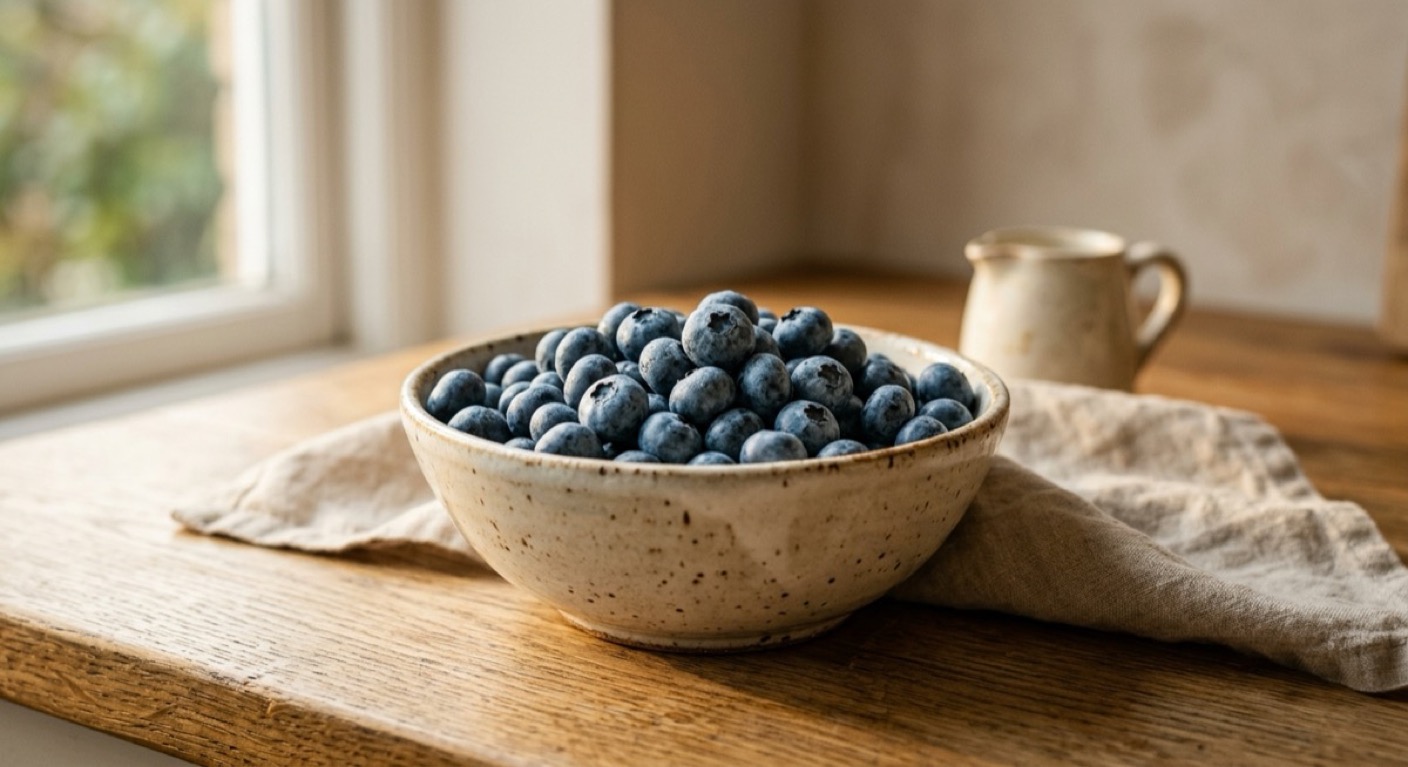
Blueberries are the most familiar dietary source of pterostilbene, though the amounts present in food are nowhere near the targeted concentration of a topical application. The delivery routes are simply incomparable.
For those already using retinol, niacinamide, or vitamin C, a pterostilbene serum or emulsion is most logically layered in after cleansing and before moisturizer. Anyone using a resveratrol product should check for overlap, since the two compounds share structural and functional similarities.
About the Study
The research was conducted by Zhiyuan Chen of Guangzhou Luanying Cosmetics and Xueping Chen of Vitargent and the Research Institute of Tsinghua University Pearl River Delta. The paper was published in the Journal of Dermatologic Science and Cosmetic Technology (DOI: 10.1016/j.jdsct.2025.100083).
Thirty-one participants is a small sample size for an exploratory clinical trial, and longer-term data across diverse skin types would be needed to fully characterize the ingredient’s effects. The two-photon microscopy data, however, moves this beyond surface-level assessment and into the structural biology of the skin, which is where the findings become genuinely interesting.
How is pterostilbene different from resveratrol? Pterostilbene is a dimethylated derivative of resveratrol, meaning two hydroxyl groups are replaced by methoxy groups. This structural change makes it more lipophilic, allowing it to penetrate the skin’s outer barrier more efficiently. Oral bioavailability is approximately 80%, compared to resveratrol’s ~20%, a roughly four-fold difference.
Can 28 days really produce visible results? In this clinical trial, forehead wrinkle volume, under-eye wrinkle area, and crow’s feet area all decreased at statistically significant levels (p<0.05) within 28 days. These are instrument-based measurements, and individual results will vary.
What foods contain pterostilbene? Blueberries are the most concentrated dietary source, with smaller amounts found in bilberries, grape skins, and almond husks. However, topical application at 0.1% concentration is an entirely different delivery route than dietary intake, and equivalent effects cannot be expected from food alone.