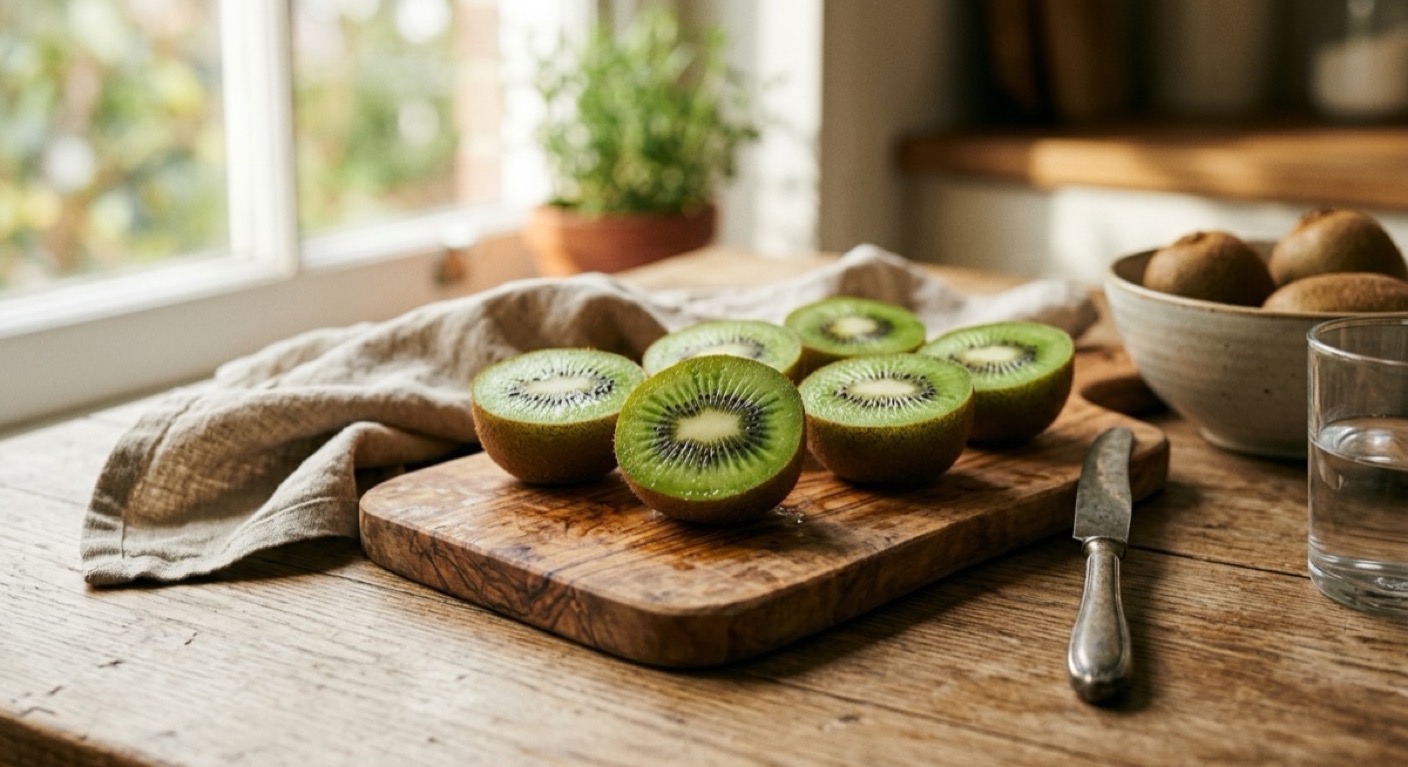
Kiwifruit Extract 8-Week Trial Cuts IBS-C Pain by 30 Percent
Irritable bowel syndrome with constipation (IBS-C) sits at an awkward intersection: it’s not dangerous, but it is persistent, unpredictable, and often resistant to simple fixes. Medications exist, but many patients look for food-based alternatives that feel less like a clinical commitment.
A double-blind randomized controlled trial published in JGH Open in August 2025 (Holtmann et al.) followed 186 adults with diagnosed IBS-C over eight weeks. The intervention: a 575mg kiwifruit extract capsule daily. The findings offer a clearer picture of what this approach can and cannot do.
IBS-C: The Most Constipation-Dominant Functional Gut Disorder
IBS is classified by the Rome IV criteria based on altered bowel habits and recurring abdominal pain without structural abnormality. The constipation-predominant subtype (IBS-C) is defined by fewer than one complete spontaneous bowel movement (CSBM) per week, alongside bloating and abdominal discomfort that doesn’t fully resolve with evacuation.
IBS-C is more prevalent in women and tends to present across the 20–50 age range. It differs from simple constipation in that pain is a core feature, not just an absence of regularity. Patients frequently describe their daily experience as managing both urgency and futility at the same time.
What Kiwifruit Does in the Gut
Three components in kiwifruit have attracted research attention for gut function.
Actinidin is a cysteine protease (a class of protein-digesting enzyme) found predominantly in green kiwifruit. It accelerates gastric emptying and protein digestion in the small intestine, and is proposed to shorten gastrointestinal transit time. Gold kiwifruit contains minimal actinidin compared to green varieties, which is why green kiwi has been the focus of most gut motility research.
Dietary fiber in kiwifruit includes both soluble and insoluble fractions. The soluble component absorbs water and softens stool; the insoluble component adds bulk. Fresh green kiwifruit contains roughly 3g of fiber per 100g.
Polyphenols, including compounds in the pectin and flavonoid family, appear to act as prebiotics — selectively feeding beneficial gut bacteria such as Bifidobacterium and Lactobacillus. The microbiome-modulating effects of kiwifruit have been studied in both constipated and healthy adults.
The 575mg capsule used in this trial concentrated these components, with actinidin as the primary active compound.
Primary Endpoint vs. Secondary Outcomes
The trial enrolled 186 participants: 94 in the kiwifruit extract group, 92 in the placebo group. Both groups took one capsule daily for eight weeks. The researchers assessed outcomes at four-week intervals.
The primary composite endpoint required participants to simultaneously achieve two things: a 30% or greater reduction in abdominal pain on a numerical rating scale (NRS), and an increase in CSBM frequency from baseline. The proportion meeting this combined threshold was 24% in the extract group versus 26% in placebo (p=0.798). No statistically significant difference.
On the surface, that’s a null result.
But the secondary outcomes moved in a different direction.
Spontaneous bowel movement frequency: 54% of the extract group achieved a meaningful increase in weekly CSBM, compared to 36% in placebo (p=0.012). An 18 percentage-point gap.
Stool consistency: 87% of the extract group reached the normal range on the Bristol Stool Scale (types 4–6) versus 73% in placebo (p=0.014).
Abdominal pain reduction of 30% or more: 74% in the extract group versus 59% in placebo (p=0.023).
Each of the three secondary outcomes reached statistical significance independently. The reason the primary endpoint didn’t: its composite design required both conditions to be met simultaneously, which is a higher bar.
Two Fresh Kiwis vs. 575mg Extract
This trial builds on earlier research where eating two fresh green kiwis per day improved constipation and IBS-C symptoms in separate RCTs. The 575mg capsule formulation attempts to isolate the active components — primarily actinidin — into a standardized, convenient form.
Fresh kiwifruit delivers actinidin alongside water content, intact dietary fiber, and whole polyphenol complexes. The extract concentrates the enzyme fraction without the bulk. What this means practically: the extract provides a reliable actinidin dose in capsule form, but doesn’t replicate the fiber volume or hydration contribution of eating whole fruit.
For people who don’t consistently eat kiwifruit or prefer a standardized supplement, the extract offers an evidence-backed alternative. For those without dietary barriers, two fresh green kiwis daily remains a well-studied option with a broader nutritional profile.
One note for anyone with known kiwifruit allergy: actinidin is one of the primary kiwifruit allergens. Concentrating it in extract form doesn’t reduce that risk.
What the Post-Hoc Subgroup Actually Tells Us
The most striking numbers in this study come from a subgroup that was identified after the main analysis. Among participants with severe baseline abdominal pain (NRS score of 50mm or above on a 100mm scale), the primary endpoint was met by 33% of the extract group versus 8% in placebo (p=0.028). That’s a fourfold difference.
Post-hoc analysis deserves caution. When a subgroup is identified after looking at the data rather than before the trial began, the result is hypothesis-generating rather than confirmatory. It can point toward where a future trial should focus, but it doesn’t replace a prospectively designed study of that specific population.
The authors acknowledged this directly. Their conclusion: a dedicated trial in IBS-C patients with severe abdominal pain is the logical next step. The 33% vs. 8% finding is an invitation for further research, not a standalone clinical recommendation.
Who Might Start Here
The extract was well tolerated across eight weeks with no serious adverse events reported. As a food-derived ingredient, the safety profile is considered low-risk compared to pharmacological options.
This approach is worth considering in a few specific situations. If constipation is the primary complaint and medication isn’t a preferred starting point. If standard first-line interventions — increased water, higher fiber intake, regular movement — have been tried without sufficient response. If abdominal pain alongside irregular bowel habits has been ongoing without a structural cause identified.
For anyone experiencing a sudden change in bowel habits, rectal bleeding, unexplained weight loss, or symptoms that worsen at night, those are signals to rule out causes beyond functional gut disorders first.
If you’re already on a prescription IBS-C medication, this isn’t a replacement — it’s a potential complement worth discussing with your doctor.
The JGH Open trial doesn’t close the question on kiwifruit extract for IBS-C. What it adds is a cleaner picture of where the benefit concentrates: bowel frequency, stool consistency, and pain reduction as separate outcomes, especially in those who are hurting more at the start.
Q. How is kiwifruit extract different from eating two fresh kiwis a day?
Two fresh green kiwis contain roughly 70–100mg of actinidin along with dietary fiber (about 4–5g), water, vitamin C, and polyphenols. The 575mg extract capsule concentrates actinidin without the bulk of water and fiber. The clinical trial tested the capsule specifically, so it’s not accurate to say the extract is equivalent to eating fresh kiwifruit daily. That said, both forms work through similar gut motility pathways.
Q. I have a kiwifruit allergy. Is the extract safe for me?
Kiwifruit allergy does occur in some people, and one of the primary allergens is actinidin itself. If you’ve experienced oral or skin reactions after eating kiwifruit, extract capsules would concentrate the same allergen. Consult a doctor or pharmacist before trying kiwifruit extract if you have a known sensitivity.
Q. Can I take kiwifruit extract alongside my current IBS medications?
The extract used in this trial is food-derived and is generally considered to have a low interaction profile with common medications. However, the study was not designed to evaluate drug interactions as a primary outcome. If you are currently taking prescription IBS-C medications such as linaclotide or lubiprostone, check with your prescribing doctor before adding a kiwifruit extract supplement.