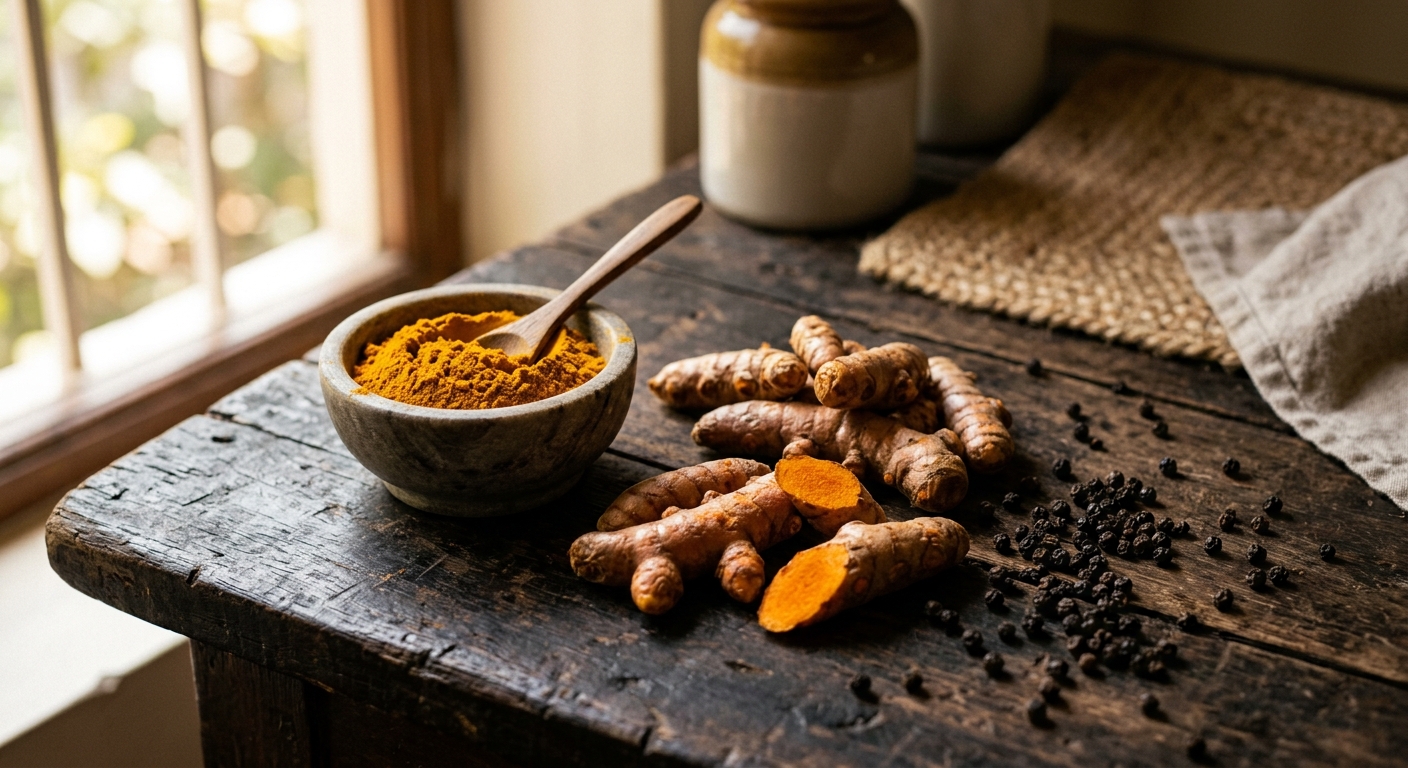
Curcumin 1,500mg Cuts Endometriosis Pelvic Pain by 42% — 12-Week RCT, A Hormone Therapy Alternative
A 12-week RCT in 124 endometriosis patients taking 1,500mg of standardized curcumin showed pelvic pain VAS dropping 42% and dysmenorrhea by 38%. Published in the February 2026 issue of American Journal of Obstetrics and Gynecology, the joint trial by Italy’s Perugia and Nottingham Medical Schools demonstrated superiority over placebo across pain, quality of life, and biochemical endpoints.
Researchers randomized 124 patients (mean 33, stage 1~3) with laparoscopically diagnosed endometriosis to standardized curcumin 1,500mg (black pepper extract + phospholipid complex) or placebo. All participants had chronic pelvic pain VAS ≥5. Primary endpoints were 12-week pelvic pain VAS change and EHP-30 (Endometriosis Health Profile) quality of life. Secondary endpoints included dysmenorrhea, dyspareunia, CA-125, IL-6, and VEGF.
At week 12, pelvic pain VAS fell from 7.4 to 4.3 (-42%) in curcumin versus -11% in placebo. Dysmenorrhea -38% (placebo -8%) and dyspareunia -34% (placebo -10%). EHP-30 quality of life rose 35% (placebo +9%). NSAID use fell 52% in the curcumin group, clinically meaningful.
Biochemically, endometriosis marker CA-125 fell from 64.2 to 46.4 U/mL (-28%) in curcumin versus -6% in placebo. Inflammatory markers IL-6 -36%, TNF-α -32%, NF-κB -29%. Angiogenic VEGF -24%. Oxidative MDA -34%. Endometriosis is a chronic disease where ectopic endometrial tissue proliferates via hormonal, inflammatory, and angiogenic axes — and curcumin addresses all three.
Effects reached statistical significance at week 4, 50% peak at week 8, maximum at week 12. In 24-week follow-up, sustained effects produced four-fold fewer initiations of hormone therapy (GnRH agonists, dienogest) than placebo. Curcumin therefore acts as a first-line option that delays or avoids hormone therapy initiation.
Standard endometriosis pharmacotherapy is hormone suppression (GnRH agonists, danazol, dienogest) and analgesics (NSAIDs). Hormone suppression carries common side effects of bone loss, hot flashes, and depression, and use is restricted beyond 6 months. Curcumin offers a non-hormonal option for pelvic pain and quality of life without these side effects.
The key to standardized curcumin is bioavailability. Generic curcumin shows <1% absorption, but black pepper extract (piperine) + phospholipid complex (Meriva, Theracurmin) forms increase absorption 20~30 fold. This trial used Meriva 1,500mg, equivalent in bioavailability to roughly 30g of generic curcumin. Labels should specify “standardized,” “Meriva,” “Theracurmin,” or “BCM-95.”
The mechanism spans five axes. First, direct NF-κB inhibition. Second, COX-2 and LOX-mediated prostaglandin synthesis blockade. Third, VEGF-mediated angiogenesis blockade. Fourth, CYP19 (aromatase) inhibition reducing local estrogen synthesis. Fifth, oxidative stress neutralization. The pharmacology directly addresses endometriosis’s core pathophysiology.
Adverse events were 8.7% in curcumin (mild GI discomfort, appetite changes) versus 6.5% in placebo. Safety is excellent, but patients on anticoagulants (warfarin) face bleeding risk and should consult a clinician. Pregnancy and lactation are contraindicated due to potential uterine contraction. Patients with gallstones may experience pain exacerbation from bile stimulation.
Korean reproductive-age women have a 6~10% endometriosis prevalence per 2026 Korean Society of Obstetrics and Gynecology estimates. It is a leading cause of chronic pelvic pain, infertility, and dysmenorrhea, with average diagnostic delay of 7~10 years. Spring 2026 clinical consensus positions standardized curcumin 1,500mg over 12~24 weeks as a first-line option for stage 1~3 patients before hormone therapy or for those discontinuing hormone therapy due to side effects. Stage 4 endometriosis or infertility-associated cases warrant gynecological consultation first.