Astragalus-Centella Saponin Blend Boosts Skin Collagen 8.7% in Dual-Route RCT
What happens when you layer a CICA cream with an oral supplement made from the same plant family? Researchers at Kaohsiung Medical University and Chia Nan University of Pharmacy & Science in Taiwan ran a 150-person double-blind, placebo-controlled RCT to find out. Their findings, published in MDPI Cosmetics, give the clearest head-to-head numbers yet on topical-only, oral-only, and combination delivery of Astragalus-Centella asiatica saponins.
What Is ACS
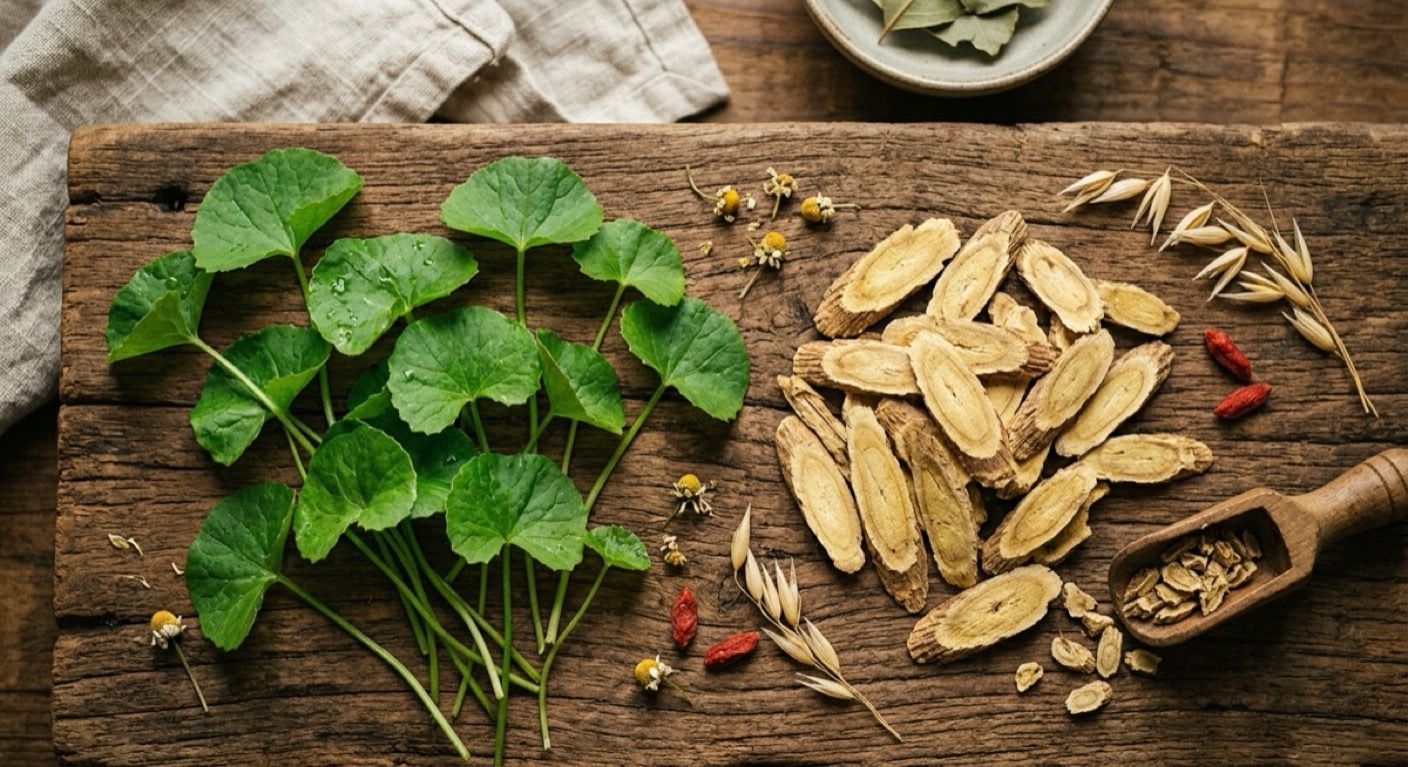
ACS stands for the combined saponin fraction of two plants: Astragalus (a root herb with a long history in East Asian medicine) and Centella asiatica (the plant behind CICA, one of the most widely used ingredients in modern skincare). Saponins are a class of plant-derived compounds known for antioxidant activity and their ability to influence collagen synthesis pathways.
Centella asiatica works primarily through madecassoside and asiaticoside, two triterpene saponins that stimulate fibroblast activity and collagen gene expression. Astragalus contributes via astragaloside, a saponin linked to cell regeneration and antioxidant defense. The ACS formulation tested here combined both into a single preparation, applied either topically as a 5% cream or delivered orally as a capsule at 125 mg twice daily.
Study Design: 150 Participants, 6 Arms
Participants were randomized into six groups of 25 each. Roughly 30% were aged 20 to 40, with the remaining 70% over 40. The cohort was predominantly female. The trial ran double-blind, meaning neither participants nor researchers knew which treatment each person received.
| Group | Treatment |
|---|---|
| 1 | 5% ACS cream (topical only) |
| 2 | ACS capsules 125 mg twice daily (oral only) |
| 3 | 5% ACS cream + ACS capsules (combination) |
| 4 | Placebo cream |
| 5 | Placebo capsules |
| 6 | Placebo cream + placebo capsules |
Skin measurements were taken at baseline and again at 4 weeks using standardized imaging equipment, covering brightness, elasticity, melanin index, pore size, and collagen density.
The Numbers at 4 Weeks
The topical ACS cream alone (Group 1) produced statistically significant results across every measured parameter (p < 0.05):
- Skin brightness +2.5%
- Elasticity +6.5%
- Melanin index -5.2%
- Pore size -10.6%
- Collagen density +8.7%
An 8.7% increase in collagen density in four weeks is not a rounding error. Collagen remodeling typically requires 8 to 12 weeks to show measurable changes in standard clinical trials. The fact that these shifts appeared in half that time points to either a sensitization of the measurement window or a faster surface-level response from the saponin fraction compared to traditional retinoids or peptides.
The combination group (Group 3) outperformed both single-route groups across all parameters. The exact magnitude of combination-group improvement was reported comparatively in the paper rather than as standalone figures, but the pattern was consistent: topical plus oral exceeded either alone on every metric.
Why Two Routes Work Better Than One
Topical delivery reaches the epidermis and upper dermis. Oral delivery routes through the bloodstream to deeper dermal layers, including the fibroblast-rich zone where most collagen is synthesized. These are not redundant pathways. They are physically distinct.
This dual-route effect has parallels in other skin supplement research. Vitamin C shows better outcomes when applied topically and taken orally simultaneously compared to either alone. The mechanism is the same: different layers, different access windows, additive rather than redundant outcomes.
Limitations Worth Noting
The study team flagged several constraints. Each arm had only 25 participants, which is sufficient for an exploratory RCT but limits the statistical power for subgroup analysis. The female-dominant composition means the results may not generalize directly to male skin, which differs in collagen density baseline and aging trajectory.
No age stratification was reported. Given that the cohort split roughly 30/70 between under-40 and over-40, it is plausible that the two age groups responded differently, but the published data does not separate them. A follow-up trial with larger groups and age-segmented analysis would clarify whether the 8.7% collagen response holds equally across age brackets.
How to Apply This
If you already use a Centella asiatica cream (look for madecassoside or Centella asiatica extract on the label), you are working in the same category as Group 1 in this study. A 5% active concentration is on the higher end of what most over-the-counter products deliver. Check the ingredient rank on your current product before assuming concentration equivalence.
For the oral side, Astragalus and Centella asiatica extracts are both available as standalone supplements and in combination beauty formulas. The study dose was 250 mg per day total (125 mg twice daily). Before adding a new supplement, check whether your current multivitamin or skin formula already includes either plant, as stacking without knowing baseline intake adds cost without necessarily adding benefit.
The core takeaway from this trial is not “more is more.” It is “same layer is not better than different layers.” Applying and ingesting the same botanical family appears to reach tissue zones that neither route covers alone.