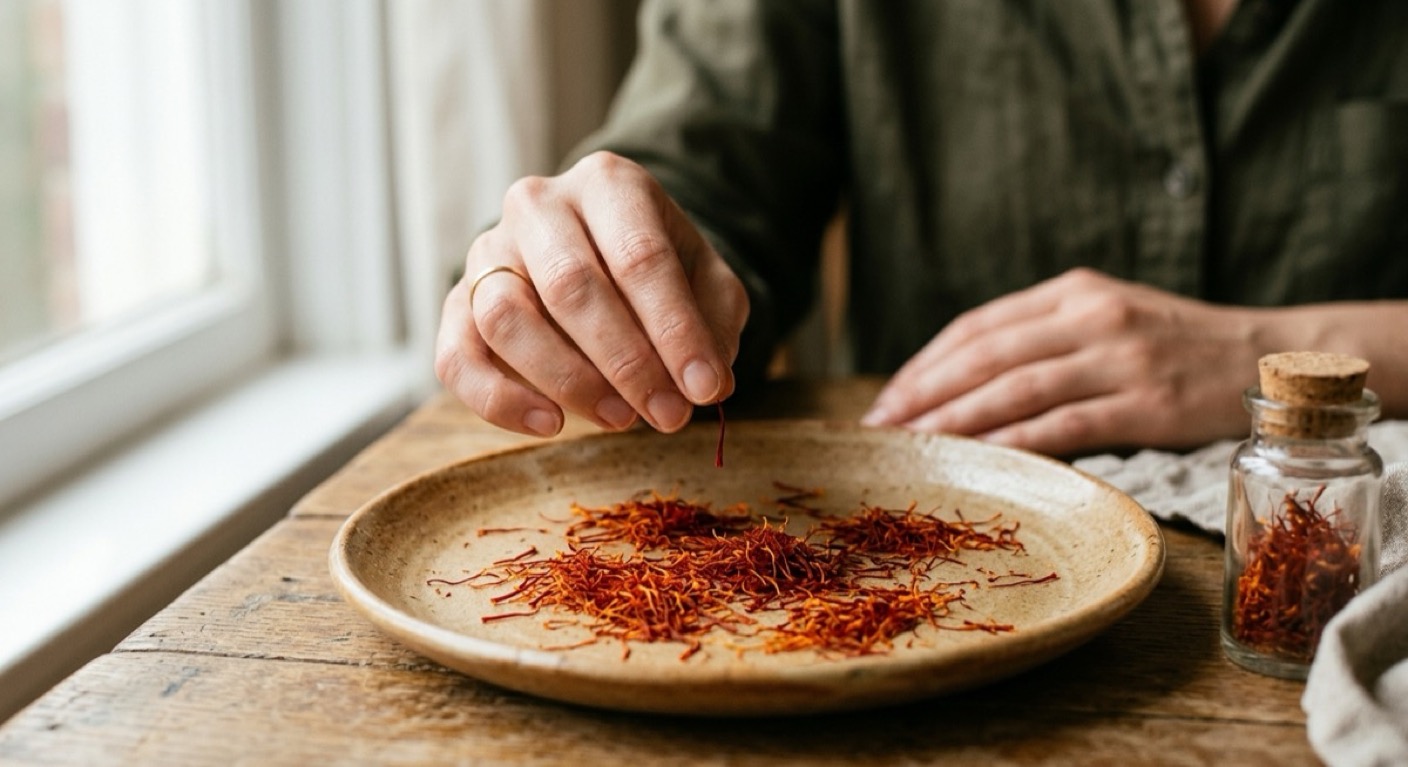
Saffron's Double Act, Fading Dark Spots and Lifting Mood at Once
Saffron (Crocus sativus) holds a rare distinction in wellness: the same compound family responsible for its vivid gold color is now at the center of two separate clinical tracks, one in dermatology addressing pigmentation, the other in psychiatry addressing mood. Both are producing data. That combination is why the ingredient is attracting renewed attention across beauty and wellbeing categories simultaneously.
For context, saffron is harvested entirely by hand. Each flower yields just three stigmas, and it takes roughly 150,000 flowers to produce one kilogram of dried saffron. That scarcity has kept prices high for centuries. What’s changed is scientific interest in what the plant’s bioactives actually do at the cellular level.
How Crocetin Interferes with Melanin Production
The primary bioactive compounds in saffron are crocin and crocetin. Crocin is the water-soluble glycoside form; the body breaks it down into crocetin, the lipid-soluble aglycone that crosses cell membranes more readily.
In B16 melanoma cell studies, crocetin suppressed tyrosinase activity in a concentration-dependent manner. Tyrosinase is the enzyme that catalyzes the rate-limiting step in melanin synthesis, the conversion of tyrosine to DOPA and then to dopaquinone. Block the enzyme, and less melanin gets made. Crocetin also downregulated MITF (melanocyte-inducing transcription factor), the master regulator of melanocyte differentiation and melanin gene expression. That dual action, enzyme inhibition plus upstream transcription control, makes the mechanism more comprehensive than simple tyrosinase blocking alone.
8-Week Topical Trial, ~24-Unit Melanin Index Drop
The cell-level findings translate into a clinical result. A trial using a cream formulated with 3% Crocus sativus extract, applied to the face daily for 8 weeks, recorded a Melanin Index decrease of approximately 24 units from baseline. The Erythema Index also improved, pointing to an anti-inflammatory effect alongside the depigmentation response.
For reference, clinical studies on alpha-arbutin and kojic acid combinations in similar split-face or parallel-group designs typically show Melanin Index reductions in the 10~30 unit range. A 3% saffron extract cream sits within the same performance band.
Saffron’s photoprotective activity adds another layer here. Ultraviolet exposure is one of the strongest triggers for melanin production. By reducing UV-induced oxidative stress in skin cells, saffron creates a secondary line of defense against pigmentation forming in the first place. The same antioxidant mechanism that inhibits melanin also contributes to the antiwrinkle and anti-inflammatory profile that appears in broader saffron skin research.
Mood, Eight Anti-Depressant Trials and a Healthy-Adult Signal
Parallel to the skin research, Crocus sativus has been evaluated across eight clinical trials comparing it against placebo or existing antidepressants for mood and depressive symptoms. Across that body of evidence, saffron showed comparable effectiveness to standard antidepressants in several of the comparisons, with a generally favorable tolerability profile.
The finding with the widest wellness application comes from a double-blind, placebo-controlled trial using Affron®, a standardized saffron extract. In healthy adults (not patients with diagnosed depression), four weeks of supplementation produced significant improvement in mood scores compared to placebo. The study population is key: this was a general wellbeing context, not a clinical intervention, and effects were still measurable.
The proposed mechanisms involve serotonin reuptake inhibition (keeping serotonin active in the synapse longer), modulation of GABA receptors, and neuroprotection through antioxidant activity. The multi-pathway action is consistent with saffron’s broader pharmacological profile across organ systems.
How to Use It in Practice
For topical brightening, the clinically tested concentration is 3% extract. When evaluating skincare products, “saffron extract” on the ingredient list without a stated percentage makes it difficult to benchmark against the research. Products from brands that disclose concentration or reference standardized saffron are easier to assess.
For oral supplementation, the clinical dosage for mood effects with Affron® is primarily in the 28~30mg per day range of standardized extract. Non-standardized powders have high batch variability, so standardized extracts are recommended for anyone specifically seeking the mood-related benefits documented in clinical literature.
Saffron in food contributes meaningful antioxidant intake, but a typical culinary serving (0.1~0.5g in a dish like paella or risotto) contains far less active compound than the supplemental doses used in trials. Diet and supplements serve different functions here.
Price range: Standardized saffron extract supplements typically run $20~$45 USD for a 30-day supply. Raw culinary saffron costs roughly $5~$15 per gram depending on origin and grade, though food-grade saffron and clinical-grade extracts are not interchangeable in terms of dosing.
One Plant, Two Research Tracks
The reason saffron appears in both dermatology and mood research is not coincidence. Crocin and crocetin are potent antioxidants, and oxidative stress is a driver in both UV-triggered hyperpigmentation and neuroinflammation-related mood disruption. The same molecules reducing reactive oxygen species in melanocytes are plausibly doing analogous work in neural tissue.
That mechanistic overlap doesn’t mean one product can deliver both outcomes at once. Topical crocetin addresses skin. Oral standardized extract addresses mood. The delivery form and target tissue are different. What the dual research track does confirm is that saffron’s bioactive profile is broad enough to justify serious formulation work in both categories at the same time.