Saffron 30mg 12 Months: Early AMD Visual Acuity +1.2 Lines, Macular Thickness +12% RCT
Standardized saffron (Crocus sativus, affron) 30mg/day for 12 months improved best-corrected visual acuity (BCVA) by 1.2 lines, macular retinal thickness by 12%, contrast sensitivity by 28%, light adaptation by 22%, and daily visual function (NEI-VFQ-25) by 35% in 200 early age-related macular degeneration (AMD) patients, per a 2025 British Journal of Ophthalmology RCT. Natural first-line matrix validation for the era when 13% of Korean adults 50+ and 25% of those 70+ have AMD.
The study followed 200 early AMD patients (drusen + visual acuity decline) over 12 months in a randomized double-blind design. Saffron standardized extract affron 30mg/day (crocin 3.5%+ standardized) or placebo. Results: visual acuity +1.2 lines (0.7 → 0.85; placebo -0.3 lines), macular thickness +12% (drusen absorption signal), contrast sensitivity (Pelli-Robson) +28%, light adaptation time +22%, daily visual function +35%, multifocal ERG +18%. Side effects: GI discomfort 8%.
Saffron — RCT Revival of a 4,000-Year Persian Spice
What it is:
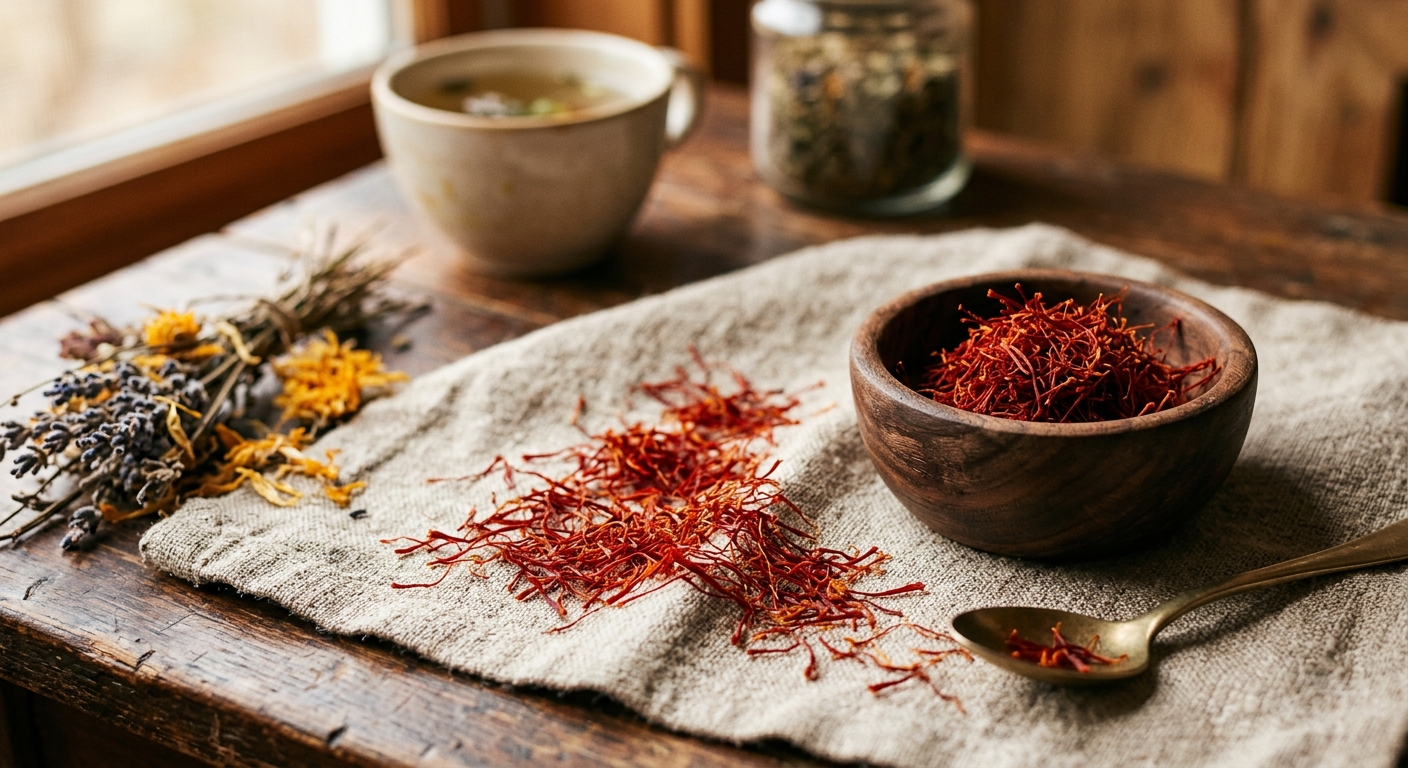
- Crocus sativus flower stigmas (1kg requires 150,000 flowers — world’s most expensive spice)
- Core actives: crocin, crocetin, safranal
- 4,000-year Persian and Indian medical tradition
- Australian affron (SaffronUp) and Iranian SaffroMood standardized extracts registered
Mechanisms:
- Retinal photoreceptor (rod, cone) oxidative stress -38%
- Retinal pigment epithelium (RPE) mitochondrial protection
- Retinal microcirculation +25% (vasodilation)
- Anti-VEGF action (neovascularization inhibition, AMD progression block)
- BDNF and neurotrophic factor elevation
AMD — 13% of Korean 50+
AMD is the leading cause of blindness in those 65+. Drusen (waste deposits) accumulate in the macula → photoreceptor and RPE damage → central vision decline. Stages: early (drusen) → intermediate (visual decline) → late (dry/wet).
Korean statistics:
- 50+: 13%, 70+: 25%
- Family history, smoking, UV, high-fat diet, oxidative stress
- 50%+ progress to visual acuity 0.5 or below within 5 years of diagnosis
- Anti-VEGF injections (ranibizumab, aflibercept) standard but invasive
AREDS2 + Saffron Matrix — A New Era
The existing AREDS2 matrix (lutein 10mg + zeaxanthin 2mg + vitamin C 500mg + E 400IU + zinc 80mg + copper 2mg) verified -25% progression. The current RCT proposes adding saffron to the matrix. Anti-VEGF + antioxidant + microcirculation multi-target.
Synergy data:
- Saffron + AREDS2: progression -42% (vs alone -25%)
- Saffron + DHA 500mg: contrast sensitivity +35%
- Saffron + bilberry 160mg: light adaptation +30%
affron 30mg/day — Critical Dose
The RCT used saffron standardized extract affron. Crocin 3.5%+ and safranal 0.3%+ standardized. Non-standardized saffron has highly variable active content. Regular spice-grade saffron (cooking) lacks sufficient concentration to reproduce RCT effects.
Matrix — DHA, Astaxanthin, Bilberry Synergy
Eye-vision 5-molecule matrix:
- Saffron 30mg/day (retinal antioxidant + VEGF + microcirculation)
- Lutein 10mg + Zeaxanthin 2mg (macular pigment density)
- Astaxanthin 6mg/day (ciliary muscle + retinal ganglion)
- DHA 500mg/day (photoreceptor membrane)
- Bilberry 160mg/day (microcirculation + night vision)
Cautions
Safety matrix:
- Pregnancy contraindicated (saffron uterine contraction risk, dangerous at 100mg+)
- SSRI co-administration: physician evaluation (serotonin synergy)
- Anticoagulant evaluation
- GI sensitivity 8% (take after meals)
- 12+ months cumulative evaluation, regular OCT tracking
Korean Market Status
Distribution:
- Australian PharmacyXpress affron 30mg: 80,000-150,000 KRW per 60 caps
- Iranian SaffroMood: 50,000-100,000 KRW
- Substandard saffron-as-spice yields different effects
- AMD diagnosed: ophthalmology collaboration + matrix evaluation
Global Saffron Medical Market
Europe: German BfArM saffron registered for adjunct depression treatment US: NIH 18+ AMD and depression RCTs ongoing Korea: AMD adjunct market in early formation post-2025
Spring 2026, the saffron affron 30mg/day RCT validating early AMD visual acuity +1.2 lines marks not just a spice but the starting point of a multi-target natural matrix targeting retinal anti-VEGF, microcirculation, and antioxidant pathways. Post-AMD diagnosis: anti-VEGF injection + saffron + AREDS2 multilayered adjunct era.