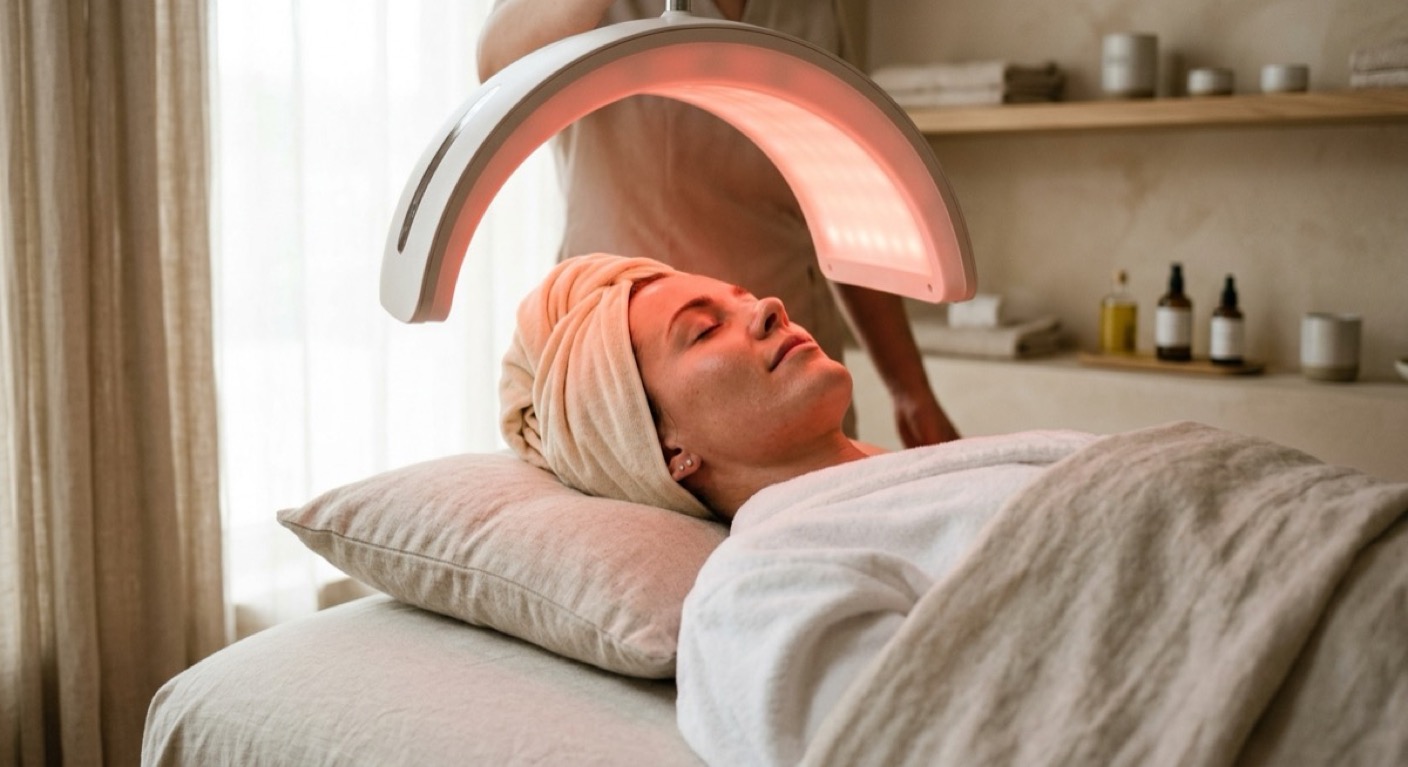
Red Light LED Therapy: Clinical Evidence for 36% Wrinkle Reduction and Collagen Boost
Red light therapy sits at the intersection of dermatology and wellness technology, and for years the evidence base has been mixed enough to keep clinicians cautious. That picture has changed.
A controlled trial published in PMC provides concrete measurements of red LED light’s effects on aging skin. The study used a split-face methodology, treating one side of participants’ faces while the other side served as an internal comparison, enabling direct measurement of the treatment effect independent of systemic factors.
36% Wrinkle Reduction, 19% Elasticity Gain
After twelve treatment sessions, the treated skin showed a 36% reduction in wrinkle depth and a 19% improvement in elasticity compared to baseline measurements. Over 90% of participants demonstrated improvement on the Fitzpatrick Wrinkling Score assessment, and 87% experienced measurable reductions in wrinkle depth.
The protocol used a combination of 640nm red light and 830nm near-infrared at an output density of 0.5mW/cm², applied for ten minutes per session. The approach is athermal, meaning it generates negligible heat, distinguishing it from laser-based treatments that rely on thermal injury for their effects.
What Happens Inside Skin Cells
The biological mechanism is called photobiomodulation. When red and near-infrared light reach the dermis, they interact with specific enzymes in cell mitochondria, primarily cytochrome c oxidase. This interaction boosts cellular ATP production and upregulates fibroblast activity.
Fibroblasts are the cells responsible for synthesizing collagen, elastin, and hyaluronic acid in the dermis. When these cells become more active, structural protein synthesis increases and tissue repair accelerates.
The 600-700nm red wavelengths penetrate to roughly 1-2mm depth, reaching the upper dermis where many fibroblasts reside. The 830nm near-infrared penetrates deeper, accessing the lower dermis and subcutaneous tissue. Combining both wavelengths targets fibroblast populations at different dermal depths simultaneously.
Stanford Medicine’s Assessment
Stanford Medicine has described red light therapy as having “fairly robust evidence” for wrinkle reduction and hair regeneration. The institution noted that evidence for other claimed applications, including certain pain conditions and wound healing, remains more mixed.
For the specific application of skin aging and wrinkle reduction, this assessment signals that multiple independent trials have produced reproducible results at a level that warrants clinical confidence.
Evaluating Consumer Devices
When evaluating home-use red light devices, the two critical specifications to verify are wavelength in nanometers and output density in milliwatts per square centimeter. The clinically validated parameters are 630-670nm or 830nm near-infrared, with output densities in the 0.1-1 mW/cm² range.
Consumer devices cannot guarantee identical outcomes to clinical-grade equipment. However, if wavelength and output specifications are verified and appropriate, the biological pathway (fibroblast activation and collagen synthesis stimulation) operates the same way regardless of the setting.
Ten minutes per session, five times per week, sustained for at least four weeks represents the minimum threshold for expecting measurable results. Pairing red light therapy with consistent UV protection creates a two-direction strategy: prevent daytime photodamage while stimulating overnight repair.