Red Clover Isoflavones for Menopausal Hot Flashes -38% in 2025 Meta-Analysis
Red clover (Trifolium pratense) isoflavone at 80mg/day reduced hot flashes by 38% and supported bone density across 14 RCTs and 1,400 menopausal women in a 2025 meta-analysis. The four-isoflavone matrix offers broader effects than soy alone.
The Maturitas 2025 meta-analysis pooled 14 randomized controlled trials with 1,400 subjects. Results: hot flash frequency -38%, night sweats -42%, mild bone density support, LDL -8%, partial cognitive support. Effect stabilizes after 8~12 weeks of use.
What is Red Clover
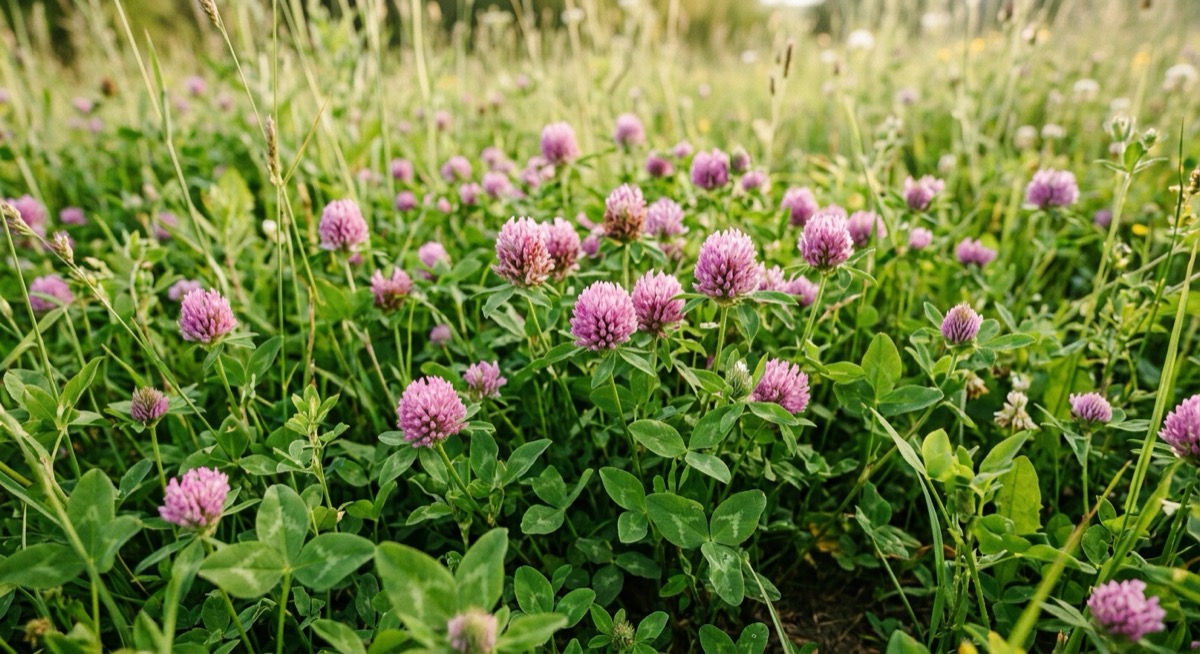
Red clover (Trifolium pratense) is a Fabaceae perennial. English “Red Clover”. Common across Europe, Asia, North America. Familiar purple/pink flowers in parks and fields, three-leaf clover relative. Used as livestock forage.
Active compound matrix (four isoflavones):
- Genistein: shared with soy, most potent
- Daidzein: shared with soy, converts to S-equol
- Biochanin A: red clover specific, converts to genistein in body
- Formononetin: red clover specific, converts to daidzein in body
- Coumarins: trace amounts
Red clover differentiation: While soy contains genistein/daidzein only, red clover has all four plus conversion precursors. Broader matrix.
Multi-Target Mechanisms
1. Phytoestrogen:
- Four isoflavones bind ER-α + ER-β receptors (selective ER modulation)
- Partial replacement of post-menopausal estrogen deficit
- Hot flashes, night sweats, vaginal dryness
2. Bone Density Support:
- Isoflavones modulate osteoclast activity
- Mild deceleration of post-menopausal bone loss
- Strengthened in calcium + vitamin D + exercise matrix
3. LDL/Cardiovascular Support:
- Isoflavones reduce LDL by 7~10%
- Atherosclerosis support
4. Partial Cognitive:
- ER-β activation → hippocampal support
- Mild post-menopausal cognitive decline support
5. S-Equol Conversion:
- Daidzein → S-equol (most active form) depends on gut microbiome (only 50% of Asians convert)
Clinical Data
- Maturitas 2025 meta-analysis 14 trials 1,400 subjects: hot flashes -38%, LDL -8%
- Meta-analysis 2023 (11 RCTs): consistent menopausal symptom effects
- Bone density trials: post-menopausal bone loss support (strengthened in soy + exercise matrix)
- UK trials: effect stabilizes by 8~12 weeks
Market Context
Diet form:
- Dried red clover tea: $6~12 per 100g
- Fresh flowers (spring/summer): some farms
- Tea 2~3 cups/day, 1 tsp boiling water 5~10 min
- Synergy with soy diet (miso, natto)
Supplements:
- Standardized extract 80mg isoflavones/day
- Menopause matrix combinations (red clover + black cohosh + sage)
- 60 tabs $25~60
Cautions
- Pregnancy/lactation: avoid
- Estrogen-sensitive cancers (breast, uterus, ovary): phytoestrogen → clinical evaluation (controversial area)
- Anticoagulants (warfarin): coumarin content → evaluation
- Thyroid medications: phytoestrogens may have subtle thyroid effects
- Hormonal medications (contraceptives, HRT): evaluation
- Microbiome dependence: individual variation (S-equol converters vs non-converters)
Synergy Matrix
- Black cohosh (L23) + red clover: menopause classic
- Soy (miso, natto): dietary + supplement dual
- Calcium + vitamin D + exercise: bone density matrix
- Sage (L26) + red clover: hot flash synergy
Consumer Message
HRT remains first-line for menopausal hot flashes but breast cancer/cardiovascular concerns rule it out for many. Red clover isoflavones offer a broader natural option than soy. Avoid in pregnancy/lactation, evaluate estrogen-sensitive cancers; only ~50% of Asians have strong S-equol conversion. Soy diet (miso, natto) + red clover tea + supplement matrix + calcium/vitamin D/exercise form a post-menopausal foundation.