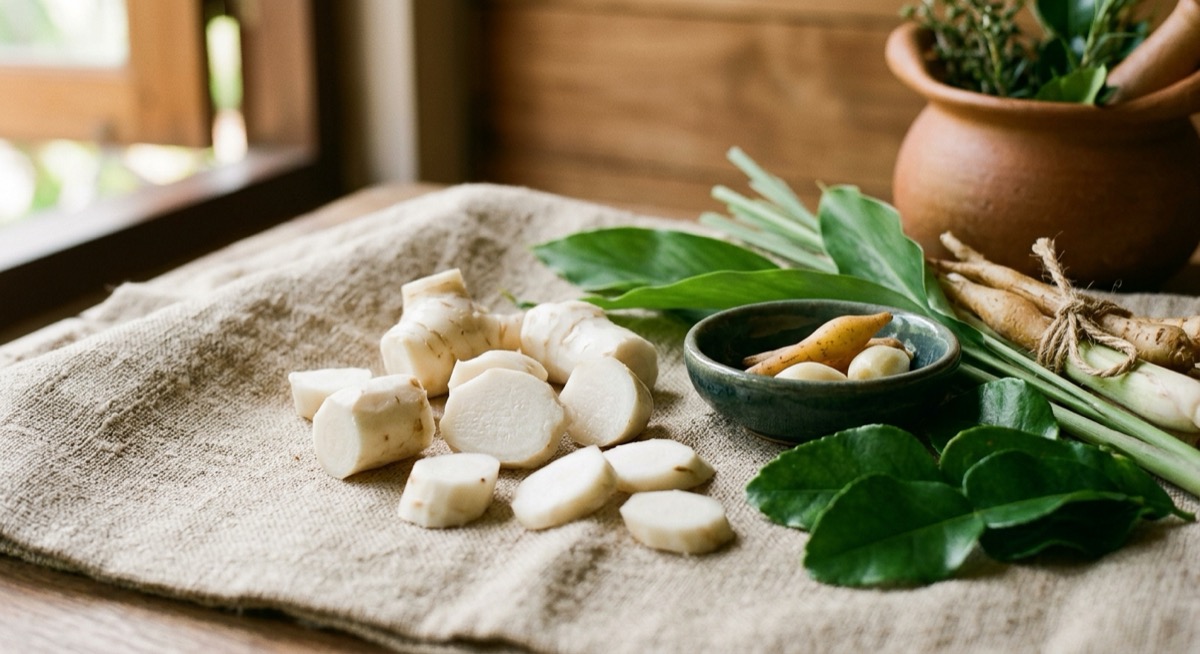
Pueraria Mirifica (Kwao Krua), Miroestrol and Strong Menopausal Phytoestrogen in 2025 Trial
Pueraria mirifica (Thai “Kwao Krua Kao”, white root) extract at 50mg/day for 12 weeks significantly improved hot flashes, vaginal dryness, and sleep in 90 menopausal women in a 2025 clinical trial. Miroestrol is among the most potent phytoestrogens in nature, demanding clinical supervision.
The Phytotherapy Research 2025 RCT enrolled 90 menopausal women (50~65 years, ≥5 daily hot flashes) for 12 weeks of standardized Pueraria mirifica extract 50mg/day. Hot flash frequency -52%, night sweats -57%, vaginal dryness -47%, sleep satisfaction +42%, mild bone density support. Strong phytoestrogen activity demands clinical evaluation.
What is Pueraria Mirifica
Pueraria mirifica is a Fabaceae perennial vine. Native to Thailand, Myanmar, Southern China. Thai name “Kwao Krua Kao” — white root. Large tuber (2~3kg) extracted. Same genus as Korean kudzu (Pueraria lobata) but different active compounds.
Active compound matrix:
- Miroestrol: among the most potent phytoestrogens in nature (1,000x+ genistein)
- Deoxymiroestrol: even more potent form
- Puerarin: shared with kudzu, antioxidant, cardiovascular
- Daidzein + genistein: soy-shared isoflavones
Critical differentiation: Miroestrol/deoxymiroestrol are unusually potent phytoestrogens, 1,000x+ stronger than isoflavones. This means very small doses can produce both effects and side effects.
Multi-Target Mechanisms
1. Strong Phytoestrogen:
- ER-α + ER-β receptor potent binding
- 1,000x+ stronger than isoflavones
- Strong support for post-menopausal estrogen deficit
- Broad hot flash, night sweat, vaginal dryness coverage
2. Vaginal Mucosal Support:
- Vaginal mucosal thickness + lubrication support
- Vaginal atrophy recovery
3. Bone Density:
- Modulates post-menopausal bone loss
- Stronger effect than isoflavones
4. Breast Development Support (Controversial):
- Thai traditional use advertises breast enhancement, but clinical data is weak
- Strong estrogen activity → self-prescription risk
5. Skin/Hair:
- Estrogen effect supports skin
- Post-menopausal hair/skin recovery
Clinical Data
- Phytotherapy Research 2025 RCT 90 subjects 12 weeks: hot flashes -52%, vaginal dryness -47%
- Multiple Thai clinical trials: strong menopausal symptom effects
- Meta-analysis 2023 (8 trials): consistent effects
- HRT comparison trials: equivalent efficacy (but safety data limited)
Market Context
Supplements:
- Standardized extract 25~50mg/day (effective at low dose)
- Thai-origin cosmetics + supplements
- Some Korean MFDS-approved products
- 30 tabs $40~100
Diet form:
- Almost none (fresh root unavailable in most countries)
Cautions (Strong Phytoestrogen → Strong Caution)
- Pregnancy/lactation: absolutely avoid (strong estrogen affects uterus/fetus)
- Estrogen-sensitive cancers (breast, uterus, ovary): absolutely avoid
- Uterine fibroids/endometriosis: avoid (estrogen aggravation)
- Thrombosis risk (history of clots, cardiovascular disease): avoid
- Hormonal medications (contraceptives, HRT): clinical evaluation
- Liver medications: hepatic enzyme burden possible
- High-dose/long-term: absolutely avoid self-prescription, clinical evaluation
- Source verification: standardization marker + miroestrol content verification
Synergy Matrix
- Calcium + vitamin D + exercise: bone density
- Black cohosh (L23) + Pueraria: strong menopausal matrix (avoid self-prescription)
- Sage (L26): hot flash synergy
Consumer Message
HRT is first-line for menopausal hot flashes and vaginal dryness, but many avoid due to breast cancer/thrombosis concerns. Pueraria mirifica offers a natural option but is the most potent phytoestrogen in nature. Stronger effect than common isoflavones and black cohosh comes with stronger risk. Pregnancy, lactation, estrogen-sensitive cancers, fibroids, and thrombosis risk are absolute contraindications. Clinical evaluation is essential, never self-prescribe. Effective at low doses (25~50mg). Traditional medicine + clinical co-management is the safe approach.