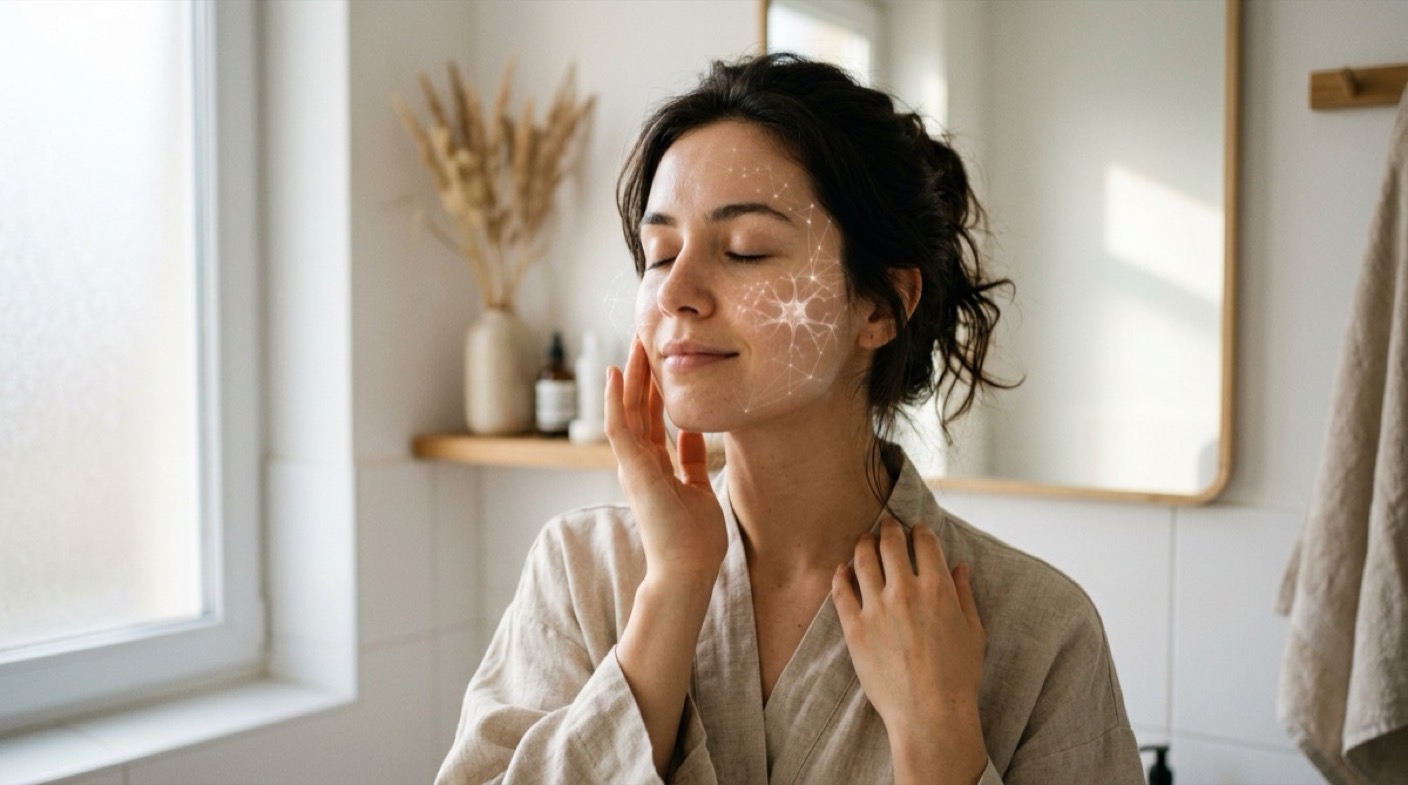
Neurocosmetics Takes Aim at the Hidden Dimension of Skin Aging
Collagen loss. Moisture barrier breakdown. Most conversations about skin aging stop there. But a third dimension has been quietly building a scientific case, and in 2026 it is starting to move into formulation labs and product pipelines: the slow decline of sensory neurons in skin.
The third dimension of aging skin
Givaudan Active Beauty, the ingredient development arm of the Swiss fragrance and flavor giant, has coined a term for this: neuro-cutaneous aging. The company proposes that skin aging operates across three distinct dimensions. Structural changes, including loss of collagen and elastic fibers. Biochemical shifts, including oxidative stress and inflammation. And now, neurosensory decline, the progressive reduction of nerve fiber density and sensory neuron signaling within the skin itself.
This third dimension has been largely invisible to cosmetic science because the tools to study it did not exist. Givaudan claims to have changed that by developing the first ex vivo reinnervated aging skin model, a laboratory construct that allows researchers to study how sensory neurons behave within aged skin tissue outside the body. The work was presented at the 35th International Federation of Societies of Cosmetic Chemists (IFSCC) Congress, where it placed in the top 10 submissions.
What sensory neurons do for skin
Sensory neurons are not passive reporters. They detect temperature, pressure, and pain, but they also release signaling compounds that regulate local inflammation, immune responses, and barrier repair. As these neurons thin out with age, the skin loses a layer of biological instruction, not just sensation.
The practical consequence is that skin’s ability to coordinate its own repair becomes less efficient. Slower turnover. Weaker barrier response. Reduced ceramide synthesis. The structural and biochemical problems that show up visibly, lines, dullness, dryness, have a neurosensory component that has not previously been targeted in formulation.
Givaudan’s ingredient results
Givaudan’s neurocosmetic active, built on this research foundation, was tested against these specific mechanisms. PrimalHyal 300, the company’s hyaluronan-based ingredient evaluated in this context, demonstrated a 79% increase in enzyme activity relevant to skin regeneration. More striking was the ceramide data: ceramide content in treated skin models increased by up to 15-fold compared to untreated controls.
Ceramides are the primary lipid components of the skin’s moisture barrier. A 15-fold increase in ceramide content represents a significant structural response, not a marginal one. Standard ceramide-targeting topicals typically aim to restore or maintain existing levels. This data points to active ceramide synthesis being triggered through the neurosensory pathway.
Symrise and the broader ingredient landscape
Givaudan is not alone in this space. Symrise, another major ingredient supplier, has brought Cellexora MD to market, an active ingredient derived from plant-based exosomes extracted from apple pomace, the pulp and skin waste from juice production. Exosomes are nano-scale vesicles that cells use to transfer signals and materials to neighboring cells. Plant-derived versions are being studied for their ability to deliver lipids, proteins, and RNA fragments into skin cells and modulate inflammatory and regenerative responses.
The use of agricultural byproducts as the source material reflects a broader sustainability movement in cosmetic ingredients, and positions plant exosomes as both a scientific and ethical proposition.
Market signals confirm the shift
The commercial indicators support the scientific momentum. Sensory-friendly beauty, a category that overlaps with neurocosmetics in targeting skin’s neural responses, grew 367.8% year over year, placing it among the fastest-expanding subcategories in beauty. The biotech-derived ingredients sector posted 10% growth overall.
A survey of patients seeking aesthetic treatments found that 84% expressed interest in regenerative approaches over conventional interventions. This is a consumer base actively looking for products that do more than cover or conceal, specifically ones that initiate a biological process.
What this means for formulation
Neurocosmetics as a category requires a different kind of testing. Efficacy cannot be measured purely through hydration or elasticity readings. It requires assessing nerve fiber density, neuropeptide release, and downstream effects on barrier and ceramide synthesis. Givaudan’s ex vivo reinnervated aging skin model provides one pathway for that validation.
The category is early, and clinical human trial data at scale remains thin. But the mechanistic groundwork, a defined aging pathway, a validated testing model, and at least two commercialized actives with measurable results, is more developed than most emerging ingredient categories at this stage.
For brands building products for women in their 30s and 40s, this third dimension of aging offers a genuinely differentiated positioning: not competing on collagen or hydration, but addressing the signaling layer that tells skin how to repair itself.
FAQ
What are neurocosmetics?
A branch of cosmetic science that targets the skin’s sensory neurons and brain-skin connection. While traditional skincare focuses on structural elements like collagen and hydration, neurocosmetics addresses the nervous system within skin itself.
Do sensory neurons really affect skin aging?
Yes. As we age, sensory neurons in skin decline, weakening regeneration signaling. This is a separate aging pathway from collagen or moisture loss.
Are neurocosmetic products available now?
Some ingredients are already commercialized. Givaudan’s PrimalHyal 300 showed a 79% increase in skin enzyme activity, and Symrise’s Cellexora MD uses plant-derived exosomes.