Nano-Curcumin Breaks the Bioavailability Wall in Rheumatoid Arthritis: Meaningful Improvement in Joint Pain and Immune Markers
The biggest reason curcumin (curcumin) had been frustrating in clinical evaluation was bioavailability. Standard curcumin has under 1% oral bioavailability, making it hard to reach clinically effective blood concentrations. The Frontiers in Immunology meta-analysis published in April 2026 consolidated trials of nano-curcumin formulations (nanomicelle, phospholipid-bound, piperine-enhanced) that overcome this limit, showing meaningful improvement in joint pain, swelling, CRP, and ESR in rheumatoid arthritis (RA) patients. Effects are clearest at 250mg+ daily doses.
RA prevalence is about 1% in Korea, with women carrying 3× higher risk than men. The autoimmune mechanism involves immune cells attacking the synovium, progressing to chronic joint inflammation, pain, and deformity. Standard treatment ladder: methotrexate (MTX) → TNF-α blockers (adalimumab, infliximab) → JAK inhibitors (upadacitinib, tofacitinib). Effective but cumulative immune suppression, infection risk, liver monitoring, and cost burden.
Curcumin’s appeal: multi-axis activity (immune modulation + anti-inflammation + antioxidation) from a natural source. Mechanisms:
1. NF-κB Signaling Blockade
Core RA inflammation circuit. Curcumin inhibits IκBα phosphorylation → blocks NF-κB nuclear translocation → reduces TNF-α, IL-1β, IL-6 expression.
2. COX-2 + LOX Blockade
Weakens prostaglandin and leukotriene synthesis. Similar circuit to NSAIDs but with less GI burden.
3. T Cell Balance
Partial Th17 differentiation suppression + partial Treg differentiation stimulation. Shifts the central balance of RA autoimmunity.
4. Synoviocyte Activity Suppression
Reduces MMP secretion by synovial fibroblasts → slows cartilage destruction.
5. Antioxidation
ROS neutralization + Nrf2 activation → increases endogenous antioxidant enzyme expression.
Bioavailability Problem and Nano Solutions
Standard curcumin:
- Under 1% oral bioavailability
- Rapid hepatic metabolism and excretion
- Blood concentration below clinical effect threshold
Solutions:
Nanomicelle curcumin:
- Encapsulates hydrophobic curcumin in micellar structure
- 10~30× absorption improvement vs standard
- 2026 RCTs report immune and symptom improvement in RA patients
Phospholipid-bound (Meriva, BCM-95):
- Phytosome form bound to phosphatidylcholine
- 5~10× absorption improvement
- Most clinically validated form
Piperine (BioPerine) enhanced:
- Black pepper extract piperine inhibits hepatic metabolism enzymes
- Standard curcumin + piperine = 20× absorption improvement
- Cheapest, most common
2026 Meta-Analysis Results
Frontiers in Immunology 2026 meta-analysis:
- DAS28 score: meaningful reduction (standard disease activity indicator)
- Tender joint count: reduced vs placebo
- Swollen joint count: reduced vs placebo
- VAS pain score: meaningful improvement
- CRP, ESR: reduced in some trials
- Some non-DAS28 indicators: no statistical difference or small
Dose and form are decisive. Below 250mg standard curcumin shows weak effect; nano forms at 250mg+ show clear effect. Cumulative use of 12+ weeks is standard.
Clinical Application Guide
- Mild to moderate RA: nano-curcumin 250~500mg/day combined with methotrexate. Pain and CRP support.
- Insufficient MTX response: nano-curcumin adjunct may avoid drug dose escalation.
- MTX side-effect patients: nano-curcumin alone is weak. Reconsider drug strategy with physician.
- Active RA on DMARD ladder: nano-curcumin is supplemental, not drug replacement.
Side Effects
- GI discomfort: mild nausea, diarrhea in some patients
- Anticoagulant interaction: bleeding risk with warfarin or aspirin. Physician consultation
- Liver injury cases: very rare but reported. Monitor LFTs at 6 months+
- Pregnancy·lactation use: limited data
Dietary Angle
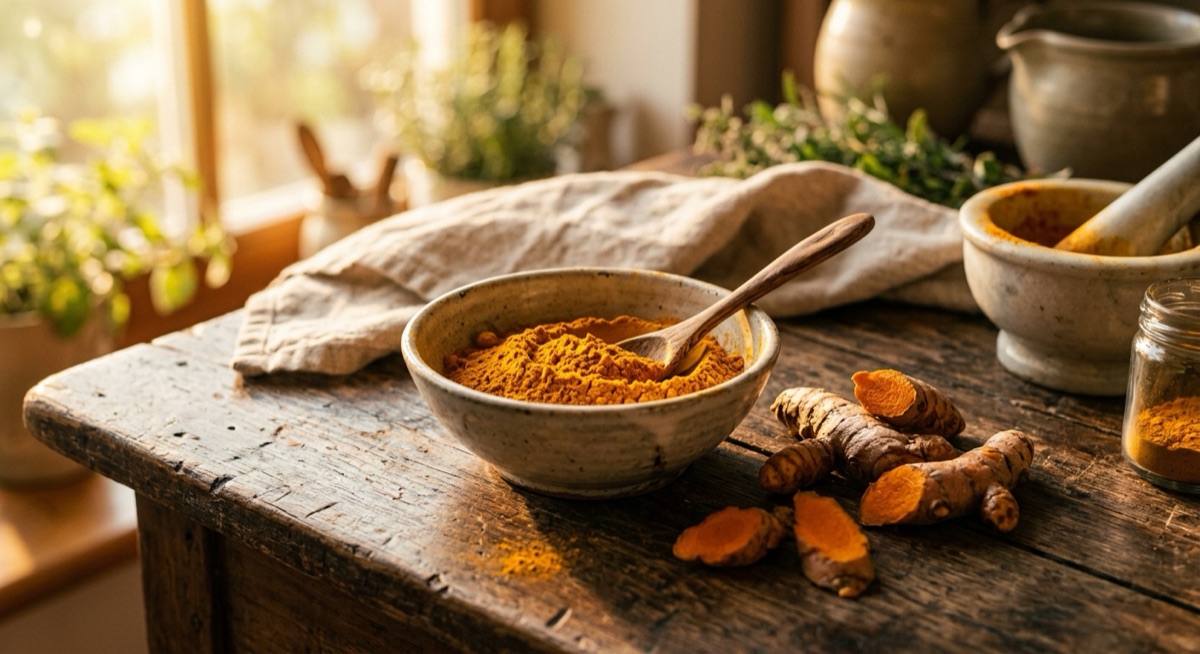
Food turmeric contains about 3% curcumin. Daily 1~2g turmeric intake through curry, golden milk, or turmeric tea is possible, but absorption limits make pharmacological effect weaker than supplementation. Diet + supplementation combination is reasonable.
For women with RA the takeaway:
- Choose nano forms (nanomicelle, phospholipid, piperine) for meaningful effect
- 250mg+ high dose for 12+ weeks cumulative is standard
- Adjunct option that does NOT replace methotrexate or biologic standard treatments
- Women planning pregnancy, bleeding risk, or liver disease patients need physician consultation