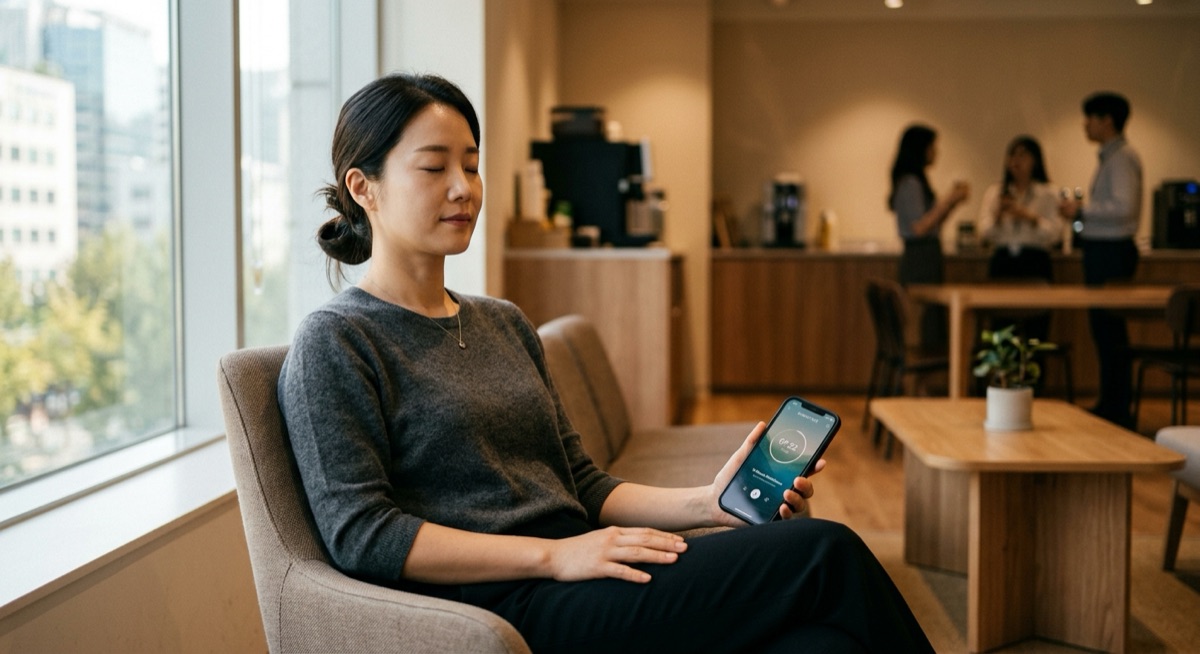
10-Min Digital Meditation RCT — 8-Week Depression·Anxiety Reduction, Effect Sustained at 8-Week Follow-up. Working Mom Barrier Broken
Meditation enters working moms’ daily life territory. medRxiv published April 19, 2026 — randomized controlled trial in 299 meditation-naive adults over 16 weeks (8-week intervention + 8-week follow-up). 10 minutes of daily remote meditation clinically meaningfully reduced depression·anxiety, with effect sustained at 8-week follow-up. Cognitive impact baseline-dependent and small. Clinical evidence that 30~40 year working moms can manage mental health via 10 minutes of commute·lunch break without “1-hour meditation retreat” entry barrier.
Historical Burden of Meditation
Traditional meditation perception:
- 1+ hour sitting practice
- Visit meditation center·dojo
- Religious or spiritual background
- ↑↑ daily entry barrier
Existing digital meditation app gap:
- Headspace·Calm·Insight Timer etc
- ↑ users but ↓ clinical data
- Personal use ≠ clinical validation
Biggest gap:
- Working moms·busy professionals can’t start
- Skepticism: “Is 10 minutes effective?”
- Clinical evidence absent
medRxiv RCT — Clinical Evidence
Study design:
- 299 meditation-naive adults
- Randomized controlled trial (RCT)
- Fully remote (home practice)
- 10 minutes daily, 8-week intervention
- + 8-week follow-up (16 weeks total)
Measurement indicators:
- Internalizing symptoms: depression·anxiety
- Cognitive function (working memory·attention·reaction time)
- Quality of life·functional recovery
Key results:
1. Depression·anxiety reduction (main effect):
- 8-week mark: significant reduction vs placebo
- Effect sustained at 8-week follow-up (post-intervention)
- Clinically meaningful effect size
2. Cognitive impact (secondary):
- Baseline-dependent
- Small effect
- Cognition itself not main change
3. Zero side effects:
- No meditation-inherent side effects
- Very low dropout
- Digital health safety validated
Why 10 Minutes Matters
Existing meditation recommendation (1 hour):
- Clinically strong effect
- But most can’t start·sustain
- Effect vs accessibility gap
10-minute recommendation:
- Effect ↓ vs 1 hour but clinically significant
- Possible to start·sustain
- Cumulative effect (8+ week duration)
- Suits working moms·professionals·students
Cases where “small amount·consistent frequency” beats “large amount·rare frequency”:
- Exercise: 30 min daily > 3 hours weekly
- Fiber: 25g daily > 50g occasionally
- Meditation: 10 min daily > 1 hour occasionally
Clinicalization of Digital Health
Digital Health:
- Apps·wearables·VR·online therapy
- L65 Oura Ring·L66 VR-CBT IBS·L66 Leqembi IQLIK home self-injection
- L68 digital meditation in same flow
Clinical evidence meaning:
- Not just “feels good” but clinical effect
- Possible physician prescription
- Possible insurance coverage (future)
US FDA “prescription digital therapeutics”:
- Some approved for depression·ADHD·diabetes
- Physician prescription + patient use
- Possible same track for meditation apps
What Meditation Apps·Programs Exist
Mass apps (some RCT):
- Headspace: largest market·some clinical data
- Calm: sleep·relaxation focus
- Insight Timer: free·diverse meditation types
- Ten Percent Happier: skeptical user target
Clinical-grade options:
- Mindfulness-Based Stress Reduction (MBSR): 8-week program·strong clinical evidence
- Mindfulness-Based Cognitive Therapy (MBCT): depression relapse prevention
- VR-CBT (L66 DDW IBS): virtual reality cognitive behavioral therapy
Korean options:
- Domestic meditation apps: Mabo·Siru·Coco Meditation
- Korean MBSR programs (university hospitals)
- Kakao Health etc digital health expansion
Who to Recommend
Strong recommendation:
- 30~50 working moms
- Chronic stress·burnout
- Mild depression·anxiety (option before prescription drugs)
- Mental burden with chronic pain·chronic disease comorbidity
- Menopause hormone fluctuation period
Physician consultation needed:
- Moderate~severe depression·anxiety (drug + meditation integration)
- Bipolar disorder·psychosis·post-traumatic stress
- Suicidal ideation
- Meditation not standalone treatment
Not recommended:
- Acute psychiatric emergency
- Active psychotic state
Meditation Mechanisms
Why effective:
1. Autonomic nervous system balance:
- ↑ parasympathetic activation
- ↓ heart rate·blood pressure
- ↓ cortisol
2. Default Mode Network (DMN) modulation:
- Weakens “mind wandering”·rumination circuits
- Adjusts depression·anxiety circuits
3. Frontal lobe strengthening:
- Attention·emotion regulation circuits
- Brain structural changes with 8+ week use (fMRI data)
4. Neurotransmitters:
- Serotonin·dopamine system stabilization
- ↑ BDNF (neuroplasticity)
Integrated Matrix — Mental Health
Daily (10-min meditation):
- 10 minutes daily
- Commute·lunch break·bedtime
- App + reminders
Weekly (exercise·social):
- Exercise 150+ min/week (mental health effect)
- Social connection
- New learning
Diet·lifestyle:
- Omega-3 (with L68 EPA caution)
- Vitamin D·B12·magnesium
- ↓ caffeine·alcohol
- 7~9 hours sleep
Drugs (if needed):
- SSRI·SNRI (physician prescription)
- L66 Auvelity (specific indications)
- Meditation as drug adjunct·not replacement
Korean Clinical Significance
Korean mental health statistics:
- Rapid increase in depression·anxiety prevalence
- Psychiatric care stigma still ↑
- ↑ self-care option demand
Korean digital meditation market:
- Active Korean apps: Mabo·Siru·Coco Meditation
- Headspace·Calm partial Korean
- Pricing: free~₩10,000/month
Working mom application:
- Office break room 10 min
- Commute subway 10 min
- Pre-bed 10 min
- Reminder·habit formation tools
Conclusion
medRxiv 10-min meditation RCT is clinical evidence of meditation entering working moms’ daily life. 8 weeks + 8-week follow-up sustained depression·anxiety reduction. Basis for digital health prescription. With L66 VR-CBT IBS·Leqembi IQLIK home + L68 digital meditation = a new slot in female digital mental health·daily precision matrix. Breaks meditation entry barrier with daily 10 minutes for lifetime mental health management. Core adjunct to drug·exercise·social·diet matrices.