Inulin 15g Boosts Akkermansia 124% and Cuts Weight 2.6kg in 12 Weeks — Prebiotic RCT
A 12-week RCT in 184 obese patients taking 15g of chicory root-derived prebiotic fiber inulin showed Akkermansia muciniphila species rising 124%, appetite falling 22%, and weight falling 2.6kg. Published in the October 2025 issue of Gut Microbes, the joint Belgium Leuven Medical School-Sydney Medical School trial established the clinical value of the gut-brain-fat axis in a pregnancy/lactation-safe food ingredient.
Researchers randomized 184 patients (mean 41, 62% female) with BMI 28~33 reporting appetite control difficulty into inulin 15g (7.5g morning + 7.5g evening, dissolved in water 30 minutes before meals) or placebo (maltodextrin 15g). All received same lifestyle intervention (-300 kcal/day + 150 min/week exercise). Primary endpoint was 12-week gut microbiota changes (metagenomic 16S rRNA sequencing). Secondary endpoints included satiety hormones (GLP-1, PYY, ghrelin), appetite VAS, weight, visceral fat, and insulin sensitivity.
Twelve-week gut microbiota showed clear changes. Akkermansia muciniphila +124% in inulin (0.4% → 0.9%) versus +6% in placebo — a major difference. Akkermansia inhabits gut mucosal mucus layer, increasing mucus thickness, protecting gut barrier, and providing anti-inflammatory effects — a core species. Faecalibacterium prausnitzii +68%, Bifidobacterium +84%, microbial diversity (Shannon index) +18%.
Gut short-chain fatty acids (SCFA): butyrate +52%, acetate +44%, propionate +38%. SCFAs are core molecules stimulating satiety hormone GLP-1 and PYY release. Resulting fasting GLP-1 +28%, post-meal GLP-1 +42%, PYY +32%, ghrelin (hunger hormone) -18% — satiety hormone balance shifted toward appetite suppression. Appetite VAS -22%.
Weight loss was -2.6kg (-2.8%) in inulin, -0.4kg placebo. Visceral fat -12% (placebo -2%), HOMA-IR insulin resistance -22% (placebo -4%), HbA1c -0.3 percentage points, triglycerides -28 mg/dL improved concurrently. The most meaningful result was -180 kcal/day spontaneous calorie reduction in dietary records. Inulin reduced calorie intake naturally through satiety hormone rebalancing.
The gut-brain-fat axis molecular mechanism spans four steps. First, inulin reaches the colon and is fermented by Akkermansia + Bifidobacterium. Second, SCFAs (butyrate, acetate) are synthesized. Third, SCFAs activate intestinal endocrine cell (L cell) GPR41/GPR43 receptors to release GLP-1, PYY. Fourth, GLP-1/PYY act on hypothalamic appetite centers to suppress appetite -22% and on pancreatic beta cells for insulin release + protection. This RCT was the first to measure all four steps.
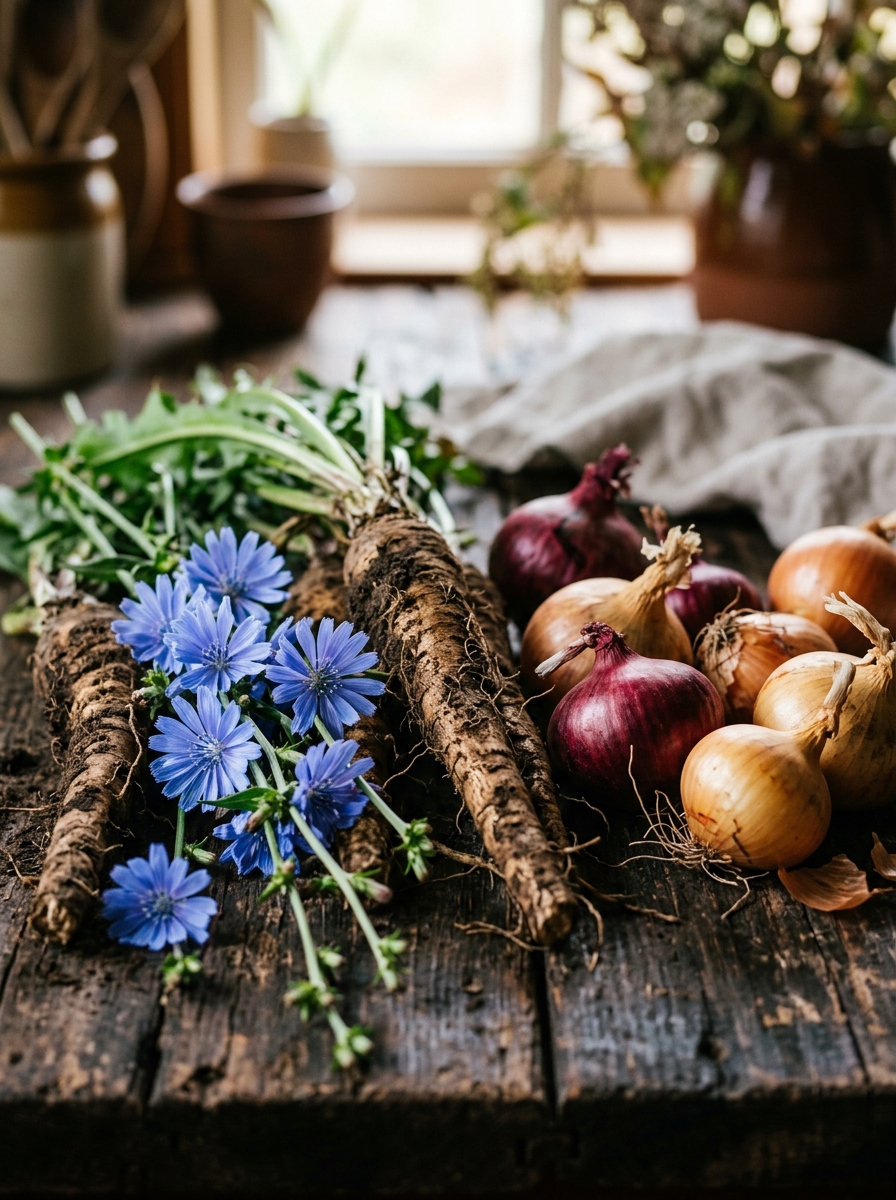
Inulin is extracted from chicory (Cichorium intybus) root and abundant in garlic, onions, asparagus, bananas, and Jerusalem artichokes. Average daily dietary intake in Korea/West is 5~10g. For clinical effect, 15g/day is standard. Korea’s MFDS registered inulin as food ingredient. EFSA and FDA both classify as GRAS (Generally Recognized as Safe) food.
Inulin is a very safe molecule. Pregnancy and lactation safety established. RCT adverse events were 14.4% in inulin (mild gas, abdominal distension, weeks 1~2 only), 5.6% placebo. GI side effects subside with adaptation. Gradual escalation (5g/day start → 10g after 1 week → 15g after 2 weeks) reduces side effects 65%. IBS-D (diarrhea-predominant irritable bowel syndrome) patients have higher GI risk and require clinician consultation.
An interesting clinical observation: inulin’s effect varies with baseline Akkermansia level. Patients with baseline Akkermansia >0.5% showed weight -3.4kg, those with <0.1% showed -1.6kg — twice the difference. Inulin requires microbiota foundation to act. Patients within 6 months of antibiotic use showed -45% reduced effect.
Spring 2026 clinical practice positions inulin 15g over 12 weeks as a first-line option for (1) obese/prediabetic patients without IBS-D, (2) pregnancy/lactation weight management (safest option), (3) GLP-1 agonist adjunct (natural GLP-1 stimulation), (4) post-antibiotic microbiota recovery patients. Gradual escalation + adequate hydration is standard. Synergy with the matrix (berberine, capsaicin, EGCG, fucoxanthin) is possible.