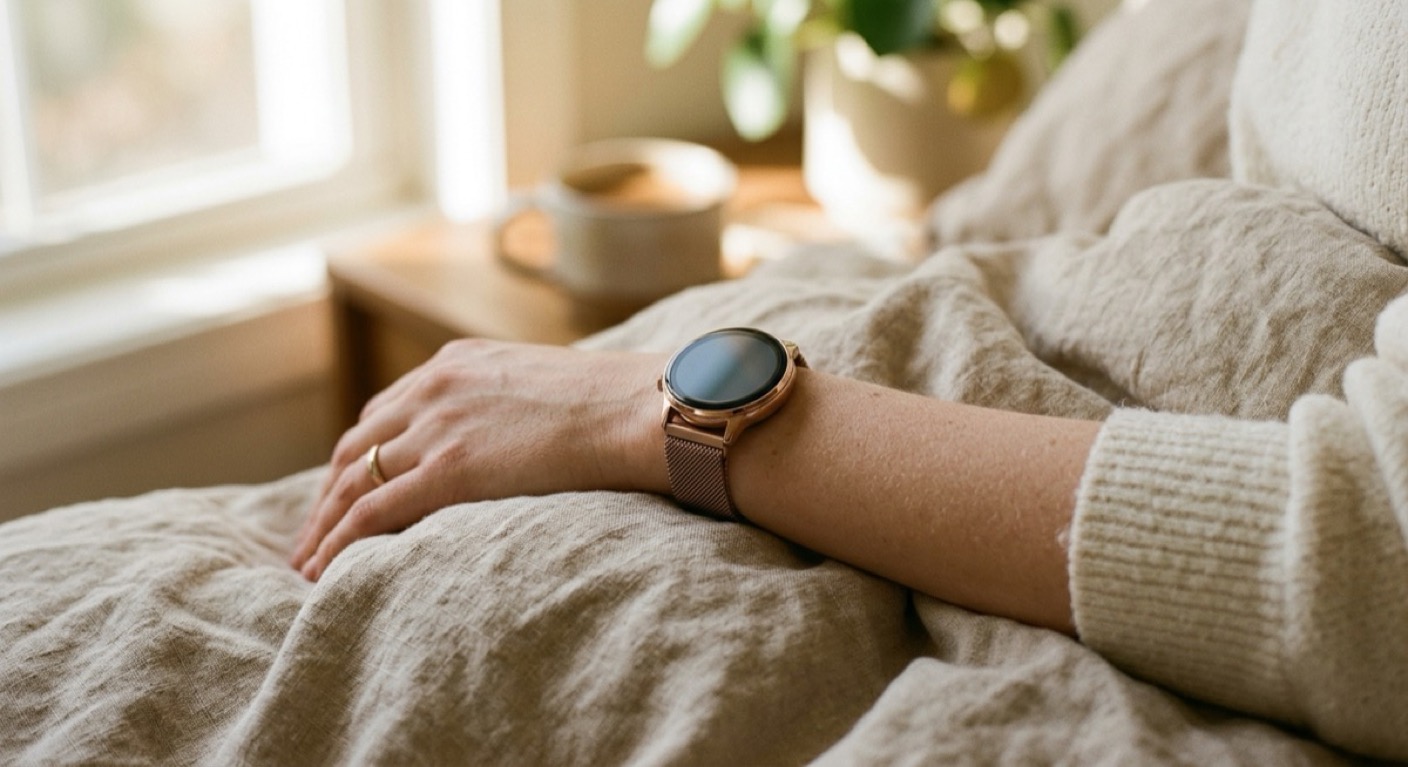
Is Apple Watch HRV Real? Five Longitudinal Studies on the Truth of Autonomic Signals
There is a number on your wrist most mornings. Apple Watch or Oura labels it HRV and presents it with the same confidence as a weather forecast. On nights when you slept poorly or skipped the gym, it is lower. On the good days, it feels like confirmation.
The question is whether the number means what you think it does.
A study published in MDPI Sensors pooled five longitudinal datasets across five wearable devices and found that Apple Watch underestimates HRV by an average of 8.31ms compared to the Polar H10 chest strap, with a mean absolute percentage error of 28.88%. At the same time, the same data showed that resting HRV tracked from a consistent baseline correlates with average blood glucose, depressive symptoms, and sleep difficulty at small-to-moderate statistical strength.
Both findings are true at once. The number on your watch is imprecise in absolute terms and meaningful in relative ones.
What HRV Actually Measures
Heart rate variability is not your heart rate. It is the variation in time between heartbeats. A heart beating 60 times per minute does not beat exactly once per second. The gap between each beat fluctuates slightly, and the size of that fluctuation is HRV.
The fluctuation is orchestrated by the autonomic nervous system, the part of your nervous system that runs without conscious input. It governs heartbeat, digestion, breathing, and blood pressure through two complementary branches: sympathetic (activation, stress, exertion) and parasympathetic (rest, recovery, sleep).
Under high stress or poor sleep, the sympathetic branch dominates. The heart beats with less flexibility. HRV drops. In a well-recovered state, the parasympathetic branch takes over and HRV rises. This is why a single HRV reading can capture what several hours of subjective self-assessment cannot.
What Five Longitudinal Studies Agreed On
The value of this analysis is in its longitudinal design. Cross-sectional snapshots can look clean but miss what actually changes over time. These five studies followed participants across weeks and months, using two smartwatches, two chest straps, and one smart ring.
Three findings were consistent.
First, resting HRV correlated with average blood glucose, depressive symptoms, and sleep difficulty at a small-to-moderate level across all five studies. This positions HRV as more than an athletic recovery metric. It reflects a broader physiological state that spans metabolic health, mood, and sleep quality simultaneously.
Second, device accuracy varied substantially for HRV. Oura Gen 4 achieved a concordance correlation coefficient of 0.99 against Polar H10 ECG across 536 nights of independent testing. WHOOP showed comparable performance. Apple Watch, by contrast, showed a mean absolute error of 20.46ms and the 95% confidence interval for error exceeded the pre-specified equivalence margin of plus or minus 10ms.
Third, resting heart rate was accurate across all devices. ICC for resting heart rate exceeded 0.95 and MAPE was below 6%. The same sensor that struggles with HRV measures your heart rate precisely. These are two different physiological calculations, not interchangeable proxies for each other.
Absolute Value vs. Trend: Which One to Follow
ICC measures consistency. MAPE measures magnitude of error. When both are reported, a device can be consistently wrong. Apple Watch HRV follows this pattern: the systematic underestimation is stable, not random, which means it produces a skewed but internally coherent reading across time.
This matters for how you use the number. Comparing your Apple Watch HRV against a published healthy adult reference range will produce a misleading result. Your 42ms does not mean the same thing as someone else’s 42ms measured on a Polar H10.
What remains valid is change within your own data stream. Is today’s reading within your personal range? Has your three-week average declined since you started working longer hours? Did last week’s sleep experiment move the trend? These relative shifts are meaningful signals regardless of the device’s absolute offset.
When to Measure: Resting vs. Active
Timing is not a minor detail. HRV measured immediately after exercise reflects acute cardiovascular load more than baseline autonomic function. Resting HRV, particularly from sleep or first-thing-upon-waking measurement, captures the underlying state.
Oura and WHOOP calculate nightly HRV from sleep data, using continuous overnight sampling as the reference window. Apple Watch recommends a breathing session measurement first thing in the morning before standing or checking your phone. Both approaches produce valid trend data if the protocol is consistent.
Coffee before the measurement, a heated argument in the first five minutes of waking, or measuring while already upright instead of lying down can each shift a reading by several milliseconds. Consistency in how you measure matters as much as the device itself.
Why It Reads Differently for Women in Perimenopause
Autonomic flexibility decreases with age, but for women, the perimenopausal transition creates an additional layer. Estrogen supports parasympathetic nervous system activity. As estrogen levels decline in the years around menopause, the autonomic nervous system loses some of its regulatory range, and baseline HRV tends to decrease structurally.
Cycle-phase variation adds another dimension before menopause. During the luteal phase (after ovulation, before menstruation), HRV drops approximately 12% and resting heart rate rises approximately 8 bpm compared to the follicular phase. Interpreting a low HRV reading without knowing where a cycle currently sits produces a false alarm or a missed signal.
This is why Oura recently developed a women’s health AI model that integrates menstrual cycle, pregnancy, and menopause data with HRV tracking. The underlying principle is the same one the five-study analysis supports: a number without hormonal context is incomplete information.
How to Track Without It Becoming Compulsive
A lower HRV reading is not evidence of malfunction. Hard training, heat exposure, alcohol, a late meal, or being in the luteal phase of a cycle can all lower HRV without anything being wrong. The signal is that the body is directing resources somewhere specific, not that it is failing.
A three-week personal calibration protocol works well. The first week, record without interpretation. The second week, note associations between HRV and sleep, exercise, alcohol, and stress. By the third week, a personal baseline range becomes visible. This range, not a population average, is the reference point worth using.
Checking whether the number is up or down daily is the most surface-level use of the data. The more useful question is which of your own behaviors reliably moves the trend in either direction.
What This Number Should Never Be Used For
HRV from a consumer wearable does not diagnose autonomic nervous system disorders, cardiovascular disease, or any clinical condition. Using a single reading to conclude that something is medically wrong, or to override clinical advice, is outside the intended scope of these devices.
A one-day low reading is also not a trend. HRV can shift by 10 to 20ms based on hydration, measurement posture, or measurement timing alone. The signal only becomes legible across multiple weeks of consistent data.
The researchers’ position is clear: HRV is well-suited for trend monitoring and personalized recovery feedback. Not for self-diagnosis. Not for benchmarking against others. For watching your own baseline move over time.
Q. Should I be worried if my Apple Watch HRV reads 8ms lower than expected?
Device-level offsets are normal and consistent. What matters is the trend from the same device measured at the same time each day. Whether your HRV is within your personal baseline range, or drifting lower over weeks, tells you far more than any single number compared to a population average.
Q. If Oura and WHOOP are more accurate, should I switch?
Accuracy differences are real. But switching devices resets your baseline from zero. If you have months of Apple Watch data, the trend history you have built may be worth more than a fresh start on a more accurate device.
Q. Why does HRV drop during perimenopause?
Estrogen supports parasympathetic (rest and recovery) nervous system activity. As estrogen declines around menopause, the autonomic nervous system loses some of its flexibility, and the variability between heartbeats narrows. This often surfaces alongside disrupted sleep and slower recovery from physical stress.