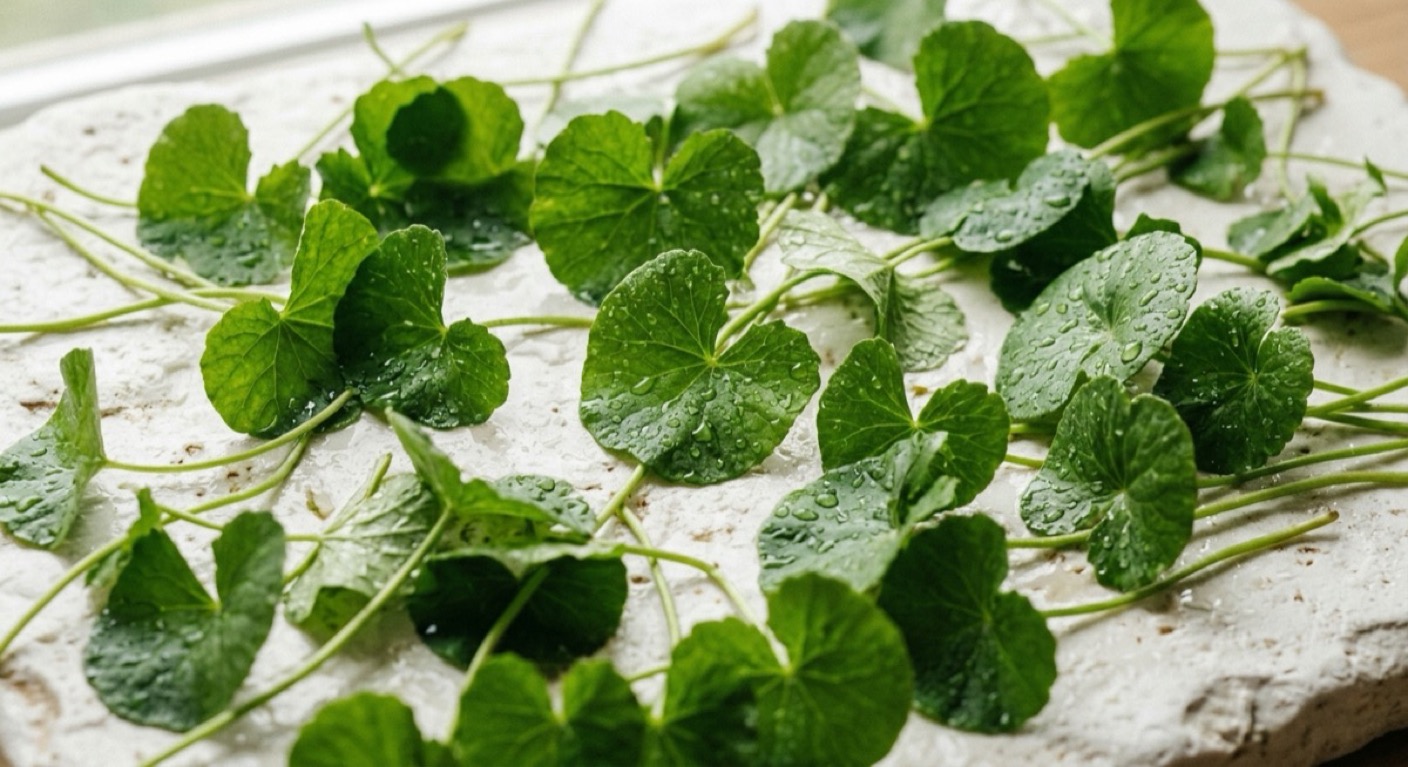
Centella TECA, How Tiger Grass Became K-Beauty's Skin Repair Standard
The name “CICA” or “tiger grass” may be more familiar than centella asiatica itself. It has become one of K-beauty’s most recognized ingredients for skin calming and barrier repair, but what exactly is inside it — and how it actually works — often stays unclear even for regular users.
TECA Is a Standardized Extract, Not Just Any Centella
Centella asiatica extract and TECA (Titrated Extract of Centella Asiatica) are not the same thing. TECA is an extraction method with a standardized ratio of active compounds:
40% asiaticoside, 30% madecassoside, and 30% asiatic acid plus madecassic acid. Research establishing centella’s clinical efficacy uses this specific combination. Products formulated to TECA standards carry more robust clinical backing than those labeled simply as “centella extract.”
How It Repairs Skin at the Cellular Level
Asiaticoside and madecassoside stimulate collagen Type I and Type III synthesis in skin fibroblasts (the cells responsible for building skin’s structural framework). This accelerates the formation of new skin tissue, which is also the mechanism behind centella’s documented wound-healing effects.
Asiatic acid and madecassic acid activate anti-inflammatory pathways. When the skin barrier breaks down, inflammatory signaling fires first. These acid components suppress that inflammatory response while creating the conditions the barrier needs to rebuild.
Transepidermal water loss (TEWL) reduction — a direct measurement of barrier integrity — has been confirmed in clinical studies within 4~8 weeks of consistent topical use. This is why dermatologists recommend centella for atopic skin, sensitivity flares, and post-laser recovery.
Why K-Beauty Made This Ingredient a Global Name
Centella asiatica has a long history in Asian traditional medicine, but its prominence in modern skincare accelerated through K-beauty’s ingredient-forward approach. Dr.Jart’s Cicapair line and COSRX’s Centella series positioned the ingredient as a premium functional active, taking it from pharmacy shelves to global skincare routines.
In Europe, Madecassol cream has been used as a prescription-grade wound treatment for decades, giving centella a documented clinical history well before the K-beauty era. K-beauty effectively amplified global awareness of what was already an established compound.
What to Check When Choosing a Topical Product
On an ingredient list, look for “Centella Asiatica Extract,” “TECA,” “Madecassoside,” or “Asiaticoside.” Placement earlier in the list indicates higher concentration. Products that specify individual active compound content are easier to evaluate than those that list centella generically.
Oral centella has low bioavailability for skin benefit, making topical application the primary recommended route for skin-related outcomes. Cica cream products typically fall in the $15~40 USD range. They layer well with moisturizers and sunscreen and are gentle enough for daily use without irritation.
Does “CICA” on a label mean the product contains TECA?
Not necessarily. “CICA” is a marketing shorthand for centella asiatica, and formulations vary widely in composition and concentration. TECA is a standardized extraction with defined active ratios; general centella extract does not guarantee the same profile. Products that specifically list madecassoside or asiaticoside in their ingredients are the clearest indication of TECA-level formulation.
Is it safe to use daily on sensitive or reactive skin?
Yes. TECA and centella carry low irritation potential and have anti-inflammatory activity, making them well suited for sensitive and atopic skin types. Dermatologists also recommend them during post-procedure recovery after laser or resurfacing treatments. As with any new product, patch testing first is the standard starting point.
Can it be used alongside retinol or vitamin C?
Yes, and it is actually a practical pairing. After retinol or vitamin C temporarily compromises the skin barrier, a TECA-based product supports barrier recovery. For layering, the general sequence is lighter textures first — vitamin C serum or retinol, then cica cream as the finishing step.