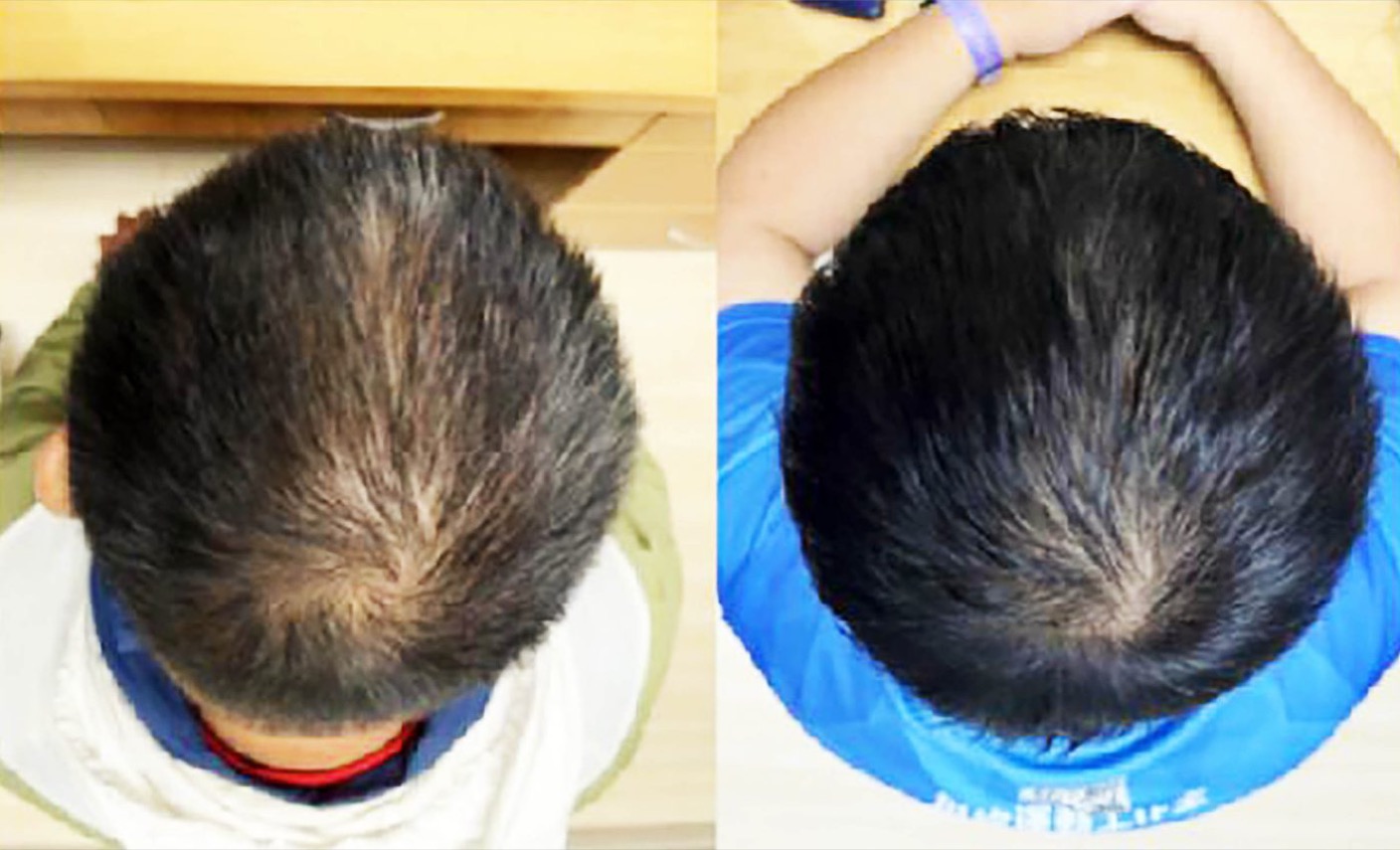
Centella Asiatica Plant Exosome Topical Serum Lifts Hair Density Nearly 25% in Eight Weeks
A research team led by Dr. Tsong Min Chang at Schweitzer Biotech Company (SBC) in Taipei posted an 8-week RCT to medRxiv that may reshape the topical hair serum standard. In 60 adults aged 18-60, a serum combining Centella asiatica-derived exosomes with growth factors raised hair density nearly 25% over 56 days.
Trial design
The RCT used a randomized, double-blind, five-arm design. Four active treatment arms plus placebo control. Sixty adults aged 18-60 applied 1 mL nightly to the scalp. Measurements were taken at days 14, 28, 42, and 56.
The formulation’s core composition.
Centella asiatica-derived plant exosomes: extracellular vesicles delivering signaling cargo to dermal hair follicle cells.
Caffeine: delays follicle entry into the resting phase and partially inhibits 5-alpha reductase activity as a secondary action.
Panthenol (provitamin B5): hydration and follicle environment stabilization.
FGF7 (Fibroblast Growth Factor 7): acts on dermal papilla cells to promote anagen phase entry.
IGF-1 (Insulin-like Growth Factor 1): activates follicle stem cells and increases hair shaft thickness.
The synergy among these five components in one formulation forms the company’s core claim.
25% hair density gain
The headline result. The active combination group showed nearly 25% greater hair density than placebo at day 56. Measurements covered hair density (count per unit area) and thickness (individual shaft diameter), and both showed meaningful change at day 56.
Mechanism distinction
The standard for topical hair formulations is minoxidil and 5-alpha reductase inhibitors (topical finasteride). This formulation differs in mechanism. It does not block 5-alpha reductase. It extends the anagen (active growth) phase.
The hair cycle has three phases: anagen, catagen, telogen. In normal scalp, about 80-90% of follicles sit in anagen, and visible hair loss progresses as that ratio falls. FGF7 and IGF-1 act directly on follicle dermal papilla cells to promote anagen entry, and plant exosomes carry signaling cargo that stabilizes the effect.
This is a hormone-independent pathway. It modulates the hair cycle directly without intervening in the androgen pathway via 5-alpha reductase inhibition. For women of reproductive age and users avoiding hormonal interventions, the mechanism distinction matters.
Same-quarter plant exosome direction
This announcement aligns with plant exosome ingredients dsm-firmenich and Symrise unveiled at in-cosmetics Global 2026 the same quarter. dsm’s Exovive Lift, combining Alpine apple, Mediterranean tangerine, and Sicilian papaya vesicles, reported 30% elasticity gain and 8-year wrinkle reduction at 2 months. Symrise’s Cellexora MD is an apple side stream-derived exosome from organic Italian sources.
A signal that plant exosomes are extending from cosmetics into hair serum. The mechanism is the same. Plant vesicles carry signaling cargo to target cells, modulating protein expression or cell cycles. Switching the target from fibroblasts (skin) to dermal papilla cells (hair) creates a new category.
Limits and follow-up validation needed
Limits of this trial are clear. First, 60 participants over 8 weeks is short for evaluating the full hair cycle. Given normal cycles span 2-7 years, 56 days captures only the early changes in follicles transitioning from telogen to a new anagen phase.
Second, participants were healthy adults, not patients with diagnosed pattern hair loss. Effect in clinical hair loss groups (androgenetic alopecia, postpartum, telogen effluvium) requires separate trials.
Third, medRxiv is a preprint server, not a peer-reviewed publication. Independent verification of effect size and safety is needed.
What changes for industry and consumers
If plant exosome hair serums settle into topical care, two changes are likely in the next 12-24 months.
First, hormone-independent options secure first-line status. 5-alpha reductase inhibitors and androgen pathway interventions face concerns (sexual function, pregnancy safety) for some users. Plant exosomes provide a mechanism alternative covering the same effect domain.
Second, the category integrates with GLP-1 hair care. GLP-1 telogen effluvium centers on disrupted hair cycles. Formulations stabilizing the cycle and promoting anagen entry are precisely the matched intervention.
For consumers, the change is simple. From a single standard of “minoxidil is the only clinically validated option” to layered options of “minoxidil plus plant exosome serum.” Different mechanisms allow combination. That said, minoxidil remains the first-line clinically validated standard with stronger effect-size evidence. The new option supplements rather than replaces.