Carotenoid Glow: How Skin Yellowness Reads as Health and Attractiveness
The warmth you notice in your skin on a bright morning reflects, in part, what you ate over the past month.
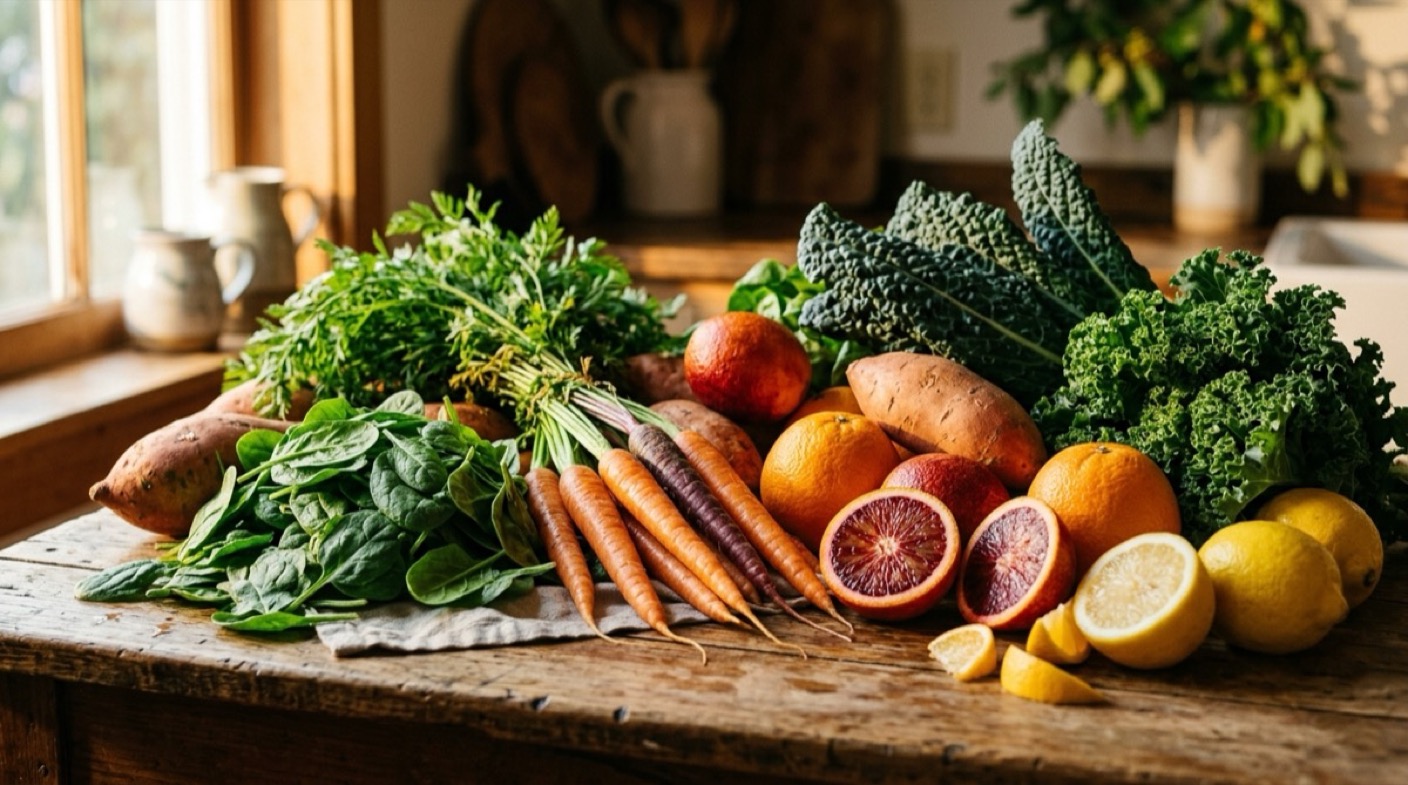
Carotenoids are pigments found in carrots, sweet potatoes, spinach, kale, and citrus. After absorption, they travel through the bloodstream and deposit in the outermost layers of the skin, creating a golden warmth visible to the naked eye. A systematic review published in Nutrients in 2025 catalogued the mechanisms and clinical outcomes for seven major carotenoid types. The pattern that runs through the data: observers read this color shift as health. And then as attractiveness.
What Creates the Golden Glow
Plants synthesize carotenoids to capture light energy and protect against oxidative damage. Humans cannot make them, so we rely entirely on diet.
After absorption through the small intestine, carotenoids are packaged into chylomicrons and carried into circulation. From the bloodstream, they migrate continuously into the stratum corneum, the outermost skin layer, and into subcutaneous fat beneath. This steady accumulation builds visible tone over weeks.
Skin color scientists use the CIELab coordinate system, where the b* axis measures yellowness. Higher b* means more yellow. Carotenoid-rich skin reliably scores higher on b*. The change is not subtle once it builds up. Researchers describe it as the “carotenoid glow,” a warm golden quality distinct from the olive tones of melanin or the flush of hemoglobin.
The 4-Week Clinical Numbers
The clearest evidence comes from controlled trials.
A single-blind randomized crossover trial (Stephen et al., PLOS ONE) enrolled 30 young women in the UK. The high-carotenoid group consumed seven daily servings of fruit and vegetables for four weeks, equivalent to 176,425 micrograms of beta-carotene per week. The low-carotenoid group was held to 2,073 micrograms per week. At four weeks, skin b* rose significantly in both sun-exposed and sun-protected areas (p<0.001 for both). Plasma concentrations of alpha-carotene, beta-carotene, and lutein all increased in parallel, and these plasma levels correlated directly with skin b* values.
A six-week randomized controlled trial conducted in Malaysia (81 participants) approached the same question differently. Participants drank 500 mL of a high-carotenoid smoothie daily, containing approximately 21 mg of beta-carotene. By week five, skin b* had risen by 3.38 points. By week seven, the increase reached 3.79. Two weeks after the intervention ended, b* remained 3.26 points above baseline. The control group showed no change at any measurement point.
Beta-Carotene, Lycopene, Lutein, Zeaxanthin: Different Colors, Different Zones
The carotenoid family contains hundreds of compounds. Their skin effects differ in both color and function.
Beta-carotene is the most studied for visible tone change. Its yellow-orange pigment deposits in the stratum corneum and produces the characteristic golden shift. In a 12-week supplementation study in British men, faces from the beta-carotene group were significantly more likely to be chosen by female observers as more attractive and healthier-looking compared to pre-supplementation baseline. No actual health markers changed. Observers were responding to color.
Lycopene, the red pigment in cooked tomatoes and watermelon, adds a warm red-pink undertone when it accumulates in skin. It tends to soften the pure yellow of beta-carotene, contributing to skin appearing warm and flushed with vitality rather than simply yellow.
Lutein and zeaxanthin are widely known for macular health, but they also deposit in the skin. In a double-blind, placebo-controlled trial (46 completers, 12 weeks, Juturu et al.), participants taking 10 mg lutein plus 2 mg zeaxanthin daily showed significantly greater improvement in skin lightness (L*) than the placebo group. Active group L* moved from 62.04 to 63.08 (p=0.0094); placebo group moved from 62.02 to 62.59 (p=0.3216). The active group also showed greater reduction in b* yellowness, and improved minimal erythemal dose (UV protection), suggesting lutein and zeaxanthin push skin toward brighter and more even-toned rather than simply more yellow.
The practical distinction: beta-carotene adds warmth and golden color; lutein and zeaxanthin brighten and even out tone while adding a more subtle warmth.
Carotenodermia: When the Palms Go Yellow
Push intake far enough and the pigment becomes visible in a way you might not want.
Carotenodermia develops when beta-carotene intake exceeds roughly 20 mg per day for several weeks. One medium carrot contains approximately 4 mg. Reaching the carotenodermia threshold requires something unusual in practice, like daily large glasses of straight carrot juice or high-dose supplement stacking.
The first sign is yellowing of the palms and soles, where sweat glands are densest and carotenoid accumulation is highest. The nasolabial folds around the nose often follow. The whites of the eyes stay clear. This is the critical diagnostic distinction from jaundice: bile pigments turn the conjunctiva yellow; carotenoids do not.
The condition is medically harmless. Reduce intake and color begins reversing within weeks. Heavy accumulation may take a few months to fully clear. The skin is not damaged.
For most people eating a varied diet, even a very vegetable-heavy one, reaching this threshold without deliberate high-dose supplementation is unlikely.
Why Astaxanthin Works Differently
Astaxanthin is a keto-carotenoid found in salmon, shrimp, and krill. It belongs to the same pigment family but operates differently in human skin.
A 16-week double-blind randomized controlled trial in 65 healthy women tested astaxanthin at 6 mg and 12 mg daily. Compared to placebo, the astaxanthin groups preserved skin elasticity and moisture significantly better, and slowed wrinkle progression. Colorimetric measurements, b* and L* values, showed minimal change.
The reason lies in molecular structure. Astaxanthin is larger and more polar than beta-carotene. It anchors across the full width of cell membranes rather than depositing in the intercellular lipid layers of the stratum corneum. This position makes it highly effective at stopping lipid peroxidation (the chain reaction that degrades membrane fats), but it does not accumulate in the same surface-visible way.
Astaxanthin’s skin role is structural defense. Beta-carotene and lutein plus zeaxanthin shift visible tone. Both functions are real. They are just different.
Makeup and Nutrition as Complementary Systems
Color cosmetics work on the surface of skin. Carotenoids work from inside. The endpoint, visible skin color, is shared; the mechanism is not.
Skin color has three biological components. Melanin determines baseline depth (influenced by UV exposure and genetics). Oxygenated hemoglobin in capillaries creates the pink-red of blood flush. And carotenoid deposits in the stratum corneum add the warm golden layer.
Foundations, blushes, and bronzers simulate the second and third components externally. Carotenoids build the third component from within, uniformly across the face and body, without washing off at night.
Observer studies that have compared carotenoid-derived skin tone to UV tan consistently find preference for the carotenoid appearance. Subjects rate golden warmth as healthier-looking than the deeper pigment of melanin increase. The two colors reflect light differently. Carotenoid-rich skin reflects more in the warm yellow-orange wavelengths; UV-tanned skin absorbs and scatters differently across a broader spectrum.
What a US Diet Can Provide
The beta-carotene amounts that produced skin changes in clinical trials are achievable without supplements.
A target of 15 to 20 mg of beta-carotene per day, the range associated with detectable skin changes, breaks down practically as follows. One medium carrot provides 7 to 8 mg. Half a cup of cooked sweet potato delivers roughly 10 mg. A cup of raw spinach contains about 1 to 2 mg. A cup of cooked kale adds another 3 to 4 mg.
Lutein and zeaxanthin are most concentrated in dark leafy greens. A cup of cooked kale delivers roughly 23 mg of lutein. A cup of cooked spinach provides approximately 20 mg. The 10 mg lutein dose used in the clinical trial above is achievable from a single substantial serving of either.
The most effective approach in practice is not high doses of one carotenoid but variety across the color spectrum. Orange-yellow vegetables (carrots, sweet potatoes, winter squash) concentrate beta-carotene and alpha-carotene. Dark green vegetables (spinach, kale, broccoli) provide lutein and zeaxanthin. Cooked tomatoes and red peppers add lycopene.
Changes in the skin take time to build. Most trials show measurable b* shifts at four weeks minimum. Consistent intake across that window is what produces the effect. Skin tone is, in a literal sense, a record of the past month’s meals.