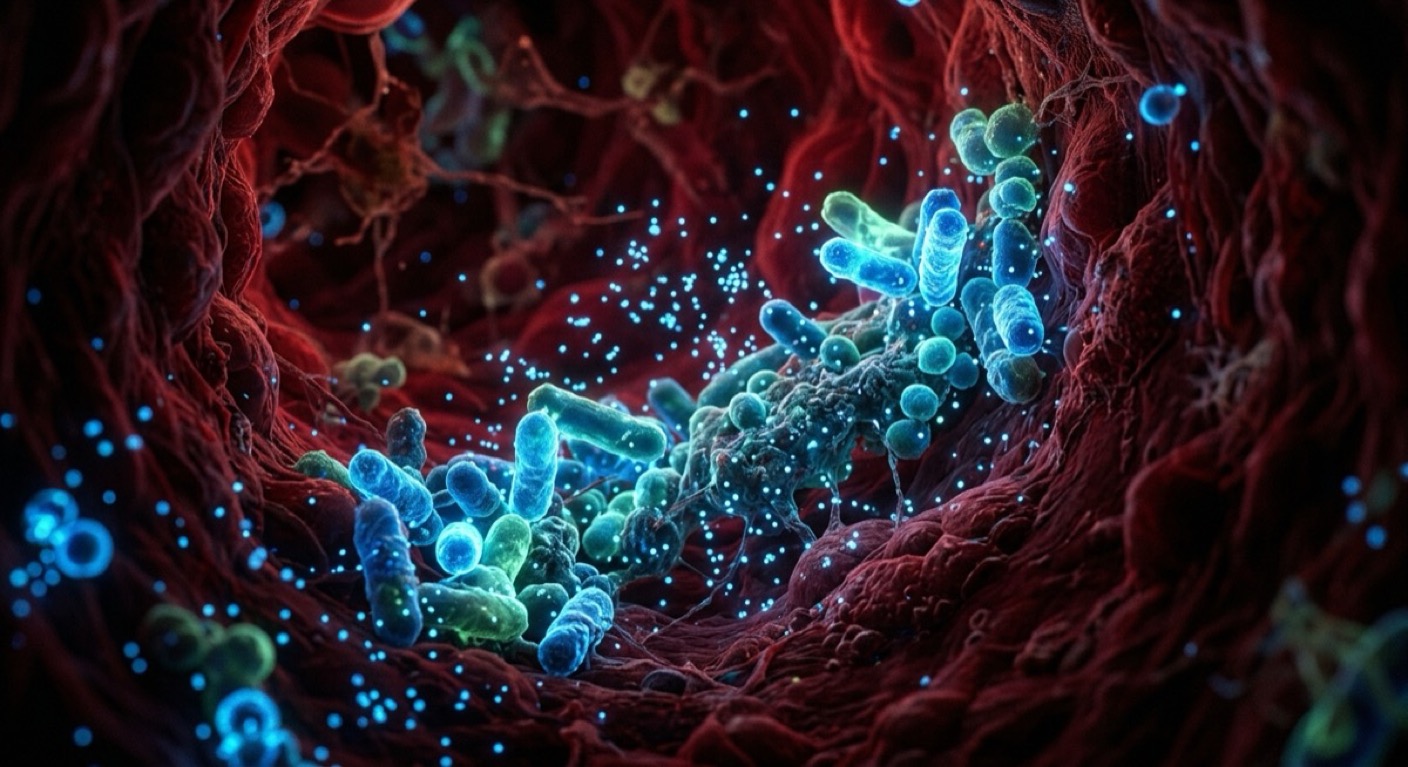
12 Anti-Aging Molecules Discovered in Blood Bacteria, Inhibiting Collagen-Degrading Enzyme
Anti-aging research keeps turning up molecules in unexpected places. The latest source: bacteria living inside human blood.
A study published in the Journal of Natural Products in 2025 describes how a Korean research team, led by Chung Sub Kim and Sullim Lee, isolated 12 indole-based metabolites from Paracoccus sanguinis, a gram-negative bacterium that naturally inhabits human blood. Six of those 12 compounds had never been reported before. Three demonstrated measurable anti-aging activity in human skin cells.
A bacterium that lives in the bloodstream
Paracoccus sanguinis was first identified in 2015. Unlike most bacteria associated with human biology, it doesn’t live in the gut or on the skin surface. It resides in the blood itself, and that environment may be exactly what makes it interesting to researchers.
Bacteria living in high-immunity environments tend to develop sophisticated chemical defense strategies. To survive where immune activity is constant, they need molecular tools that counter oxidative stress and inflammation. The compounds they produce in the process are, in effect, ready-made anti-aging candidates.
The researchers focused specifically on indole derivatives. Indoles are cyclic molecules derived from tryptophan (an essential amino acid) and are known for antioxidant, anti-inflammatory, and cytoprotective properties. From the bacterium’s culture medium, the team extracted 12 indole-based metabolites, catalogued them, and then tested their biological activity in human skin cells.
Three compounds, three mechanisms
The experiment used normal human dermal fibroblasts (NHDFs), the cells responsible for producing collagen in the dermis. To simulate chronically inflamed skin, the researchers stimulated the cells with TNF-alpha, a cytokine that drives inflammation and accelerates aging-related skin changes.
Compounds 1, 6, and 11 stood out. All three acted through overlapping but distinct pathways.
ROS suppression: Reactive oxygen species are byproducts of cellular metabolism that oxidize cell membranes, proteins, and DNA. Accumulation of ROS is one of the primary drivers of cellular aging. All three compounds reduced ROS generation in the stimulated fibroblasts.
MMP-1 inhibition: Matrix metalloproteinase-1 is the enzyme directly responsible for collagen breakdown in skin. UV exposure, chronic inflammation, and aging all trigger MMP-1 overactivation, which gradually destroys the collagen framework that keeps skin firm and plump. All three compounds inhibited MMP-1 secretion.
IL-6 and IL-8 reduction: Interleukins 6 and 8 are pro-inflammatory signaling proteins (cytokines). Persistently elevated IL-6 and IL-8 interfere with collagen synthesis and accelerate fibroblast damage. All three compounds lowered both cytokine levels.
Among the three, compound 11 showed the strongest overall anti-aging effect across all measured parameters.
What this means for skin aging science
Collagen loss in skin isn’t a single event. It’s a cascade: inflammation triggers cytokine release, cytokines activate MMP-1, and MMP-1 degrades the collagen matrix. An ingredient that interrupts this chain at multiple points simultaneously is more valuable than one that targets only a single step.
What makes the indole derivatives from Paracoccus sanguinis notable is exactly this multi-pathway profile. Rather than blocking one signaling molecule, compounds 1, 6, and 11 appear to reduce oxidative load, quiet inflammatory signaling, and suppress the enzyme that does the structural damage.
That said, this research remains in the early stage. The experiments were conducted in cell culture only. No animal studies or human clinical trials have been conducted, and the compounds have not been formulated into any skincare or supplement applications. Whether they can be extracted at scale, delivered to skin cells through topical or oral routes, and remain stable in formulation are all open questions.
The research was supported by the National Research Foundation of Korea and the BK21 FOUR Program.
Skin aging biology is expanding faster than the ingredient lists on most product labels. The discovery that a bacterium found inside human blood carries compounds capable of protecting collagen-producing cells is a reminder that the search for effective anti-aging molecules is far from over.
Where is Paracoccus sanguinis found?
It’s a gram-negative bacterium naturally present in human blood, first identified in 2015. It produces indole-based compounds with anti-inflammatory and anti-aging properties.
How does MMP-1 affect skin?
MMP-1 (matrix metalloproteinase-1) is an enzyme that breaks down collagen. When overactivated by UV exposure, stress, or aging, it destroys structural proteins in skin, leading to wrinkles and loss of firmness.
Can these findings be applied now?
Not yet. The research was conducted in cell culture models only. No human clinical trials have been performed, and further studies are needed before any skincare products or supplements can be developed.