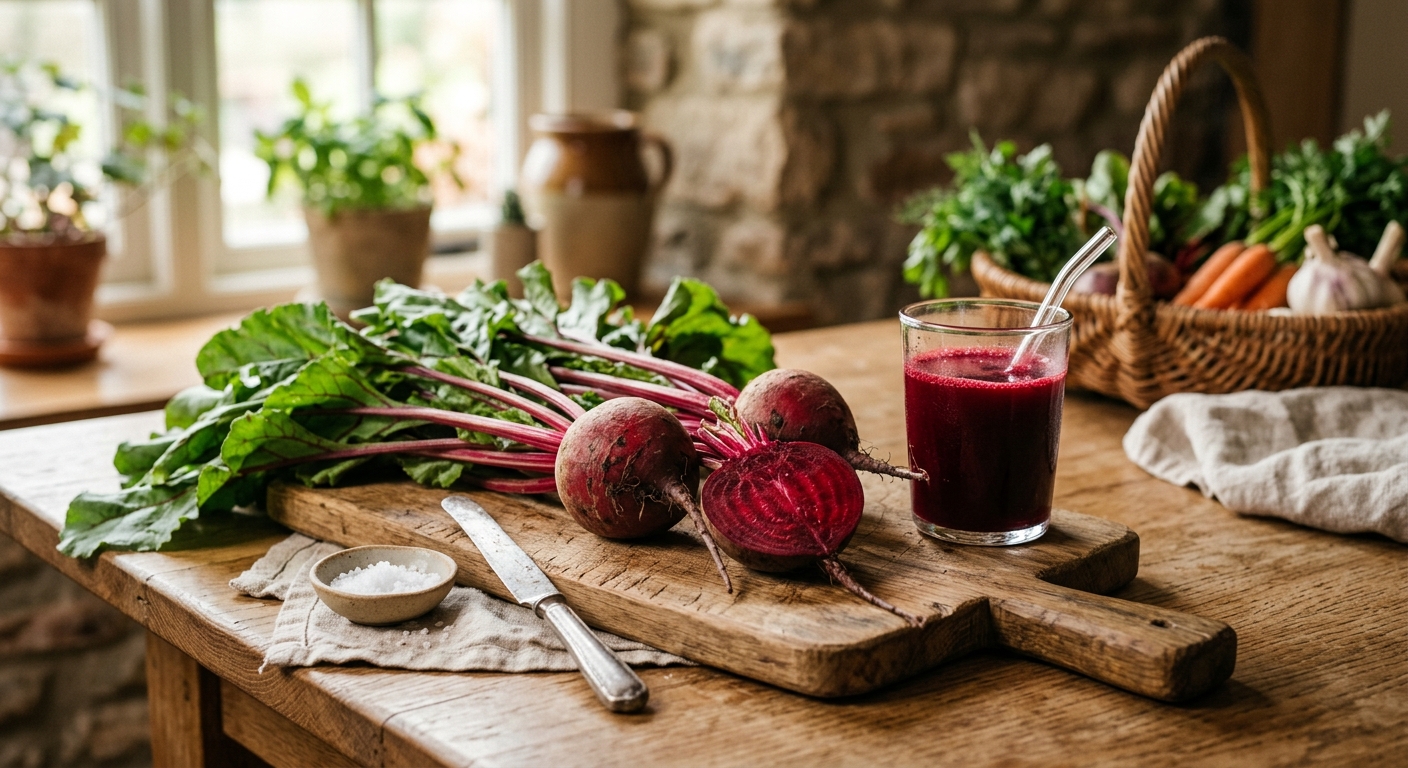
Beetroot Juice 400mg Nitrate, 6-Week +12% Frontal Blood Flow with +9% Post-Exercise Cognition
A 6-week RCT of beetroot juice 400 mg nitrate/day improving frontal cerebral blood flow and post-exercise cognitive scores in adults aged 65~75 has been published. The mechanism — dietary nitrate converted to nitric oxide (NO) producing vasodilation — has been clinically validated again.
Clinical Data
A double-blind RCT in 180 adults aged 65~75 randomized 1:1 to concentrated beetroot juice (400 mg nitrate/day, ~70 ml) versus nitrate-removed placebo juice. After 6 weeks, the primary endpoint was frontal cerebral blood flow measured by arterial spin labeling MRI; the secondary endpoint was Stroop test cognitive score after 30 minutes of light walking.
The beetroot juice arm showed +12% frontal flow (p<0.001) and +9% post-exercise Stroop score (p=0.005). The 70~75 subgroup showed amplified effects (+15% flow). Resting cognitive scores varied -2 to +3%, while differences emerged in post-exercise measurement.
Flow-mediated dilation (FMD) measured 24 hours after a 6-mile walk improved +2.8%. Plasma nitrite (+180%) and nitrate (+320%) — markers of NO metabolism — both rose substantially.
Mechanism: The NO Pathway Begins in the Mouth
The conversion of dietary nitrate to NO is intriguing. Food → GI absorption → liver transport → ~25% secreted via salivary glands → oral bacteria (especially Veillonella and Actinomyces on the posterior tongue) reduce nitrate (NO₃⁻) to nitrite (NO₂⁻) → swallowing → gastric acid environment converts nitrite to NO.
Implication: antibacterial mouthwash kills oral bacteria, reducing NO production. Clinical trials show antimicrobial mouthwash users experience -50% beetroot juice efficacy. Preserving the natural NO pathway requires oral environment management.
NO relaxes vascular smooth muscle and increases microvascular flow. Endogenous NO synthesis declines -40~50% after age 70, so external dietary nitrate supplementation produces larger effects.
Whole Food vs Concentrate
To obtain 400 mg nitrate from whole foods: 250~300 g beets, 200 g spinach, 100 g arugula, 200 g celery. Concentrated beetroot juice 70~100 ml is most efficient. Note: betalain pigments may temporarily turn urine and stool red (beeturia, harmless).
Clinical Application
- Standard dose: 400~600 mg nitrate/day with meals
- Whole food: 250~300 g beets/day or 70~100 ml concentrated beetroot juice
- Timing: 90~150 minutes before cognitive activity or exercise
- Absorption: slightly enhanced with dietary fat
- Side effects: beeturia (harmless); mild GI irritation possible in those with high gastric acidity
- Contraindication: hypotension risk with PDE5 inhibitors (sildenafil, tadalafil). Consult physician if on antihypertensives
- Synergistic matrix: combined with EGb 761 + cocoa flavanols + citicoline reinforces microvasculature + neural membrane + flow simultaneously
Dietary nitrate is the most food-friendly molecule in the cerebral and microcirculation matrix. While the other four molecules require supplements, beetroot juice delivers sufficient effect through diet alone. It has established itself as the dietary axis of the matrix.