Bakuchiol Matches Retinol's Effects with Far Less Irritation
Retinol has been the gold standard in anti-aging skincare for decades. Its ability to increase cell turnover, stimulate collagen synthesis, and reduce photoaging is supported by more randomized controlled trials than almost any other topical ingredient. The problem for a significant portion of users is that retinol irritates. Redness, peeling, stinging, and photosensitivity are common enough that many people discontinue use before reaching the concentrations that deliver results. Bakuchiol has emerged as the leading candidate to address that gap.
What bakuchiol is and where it comes from
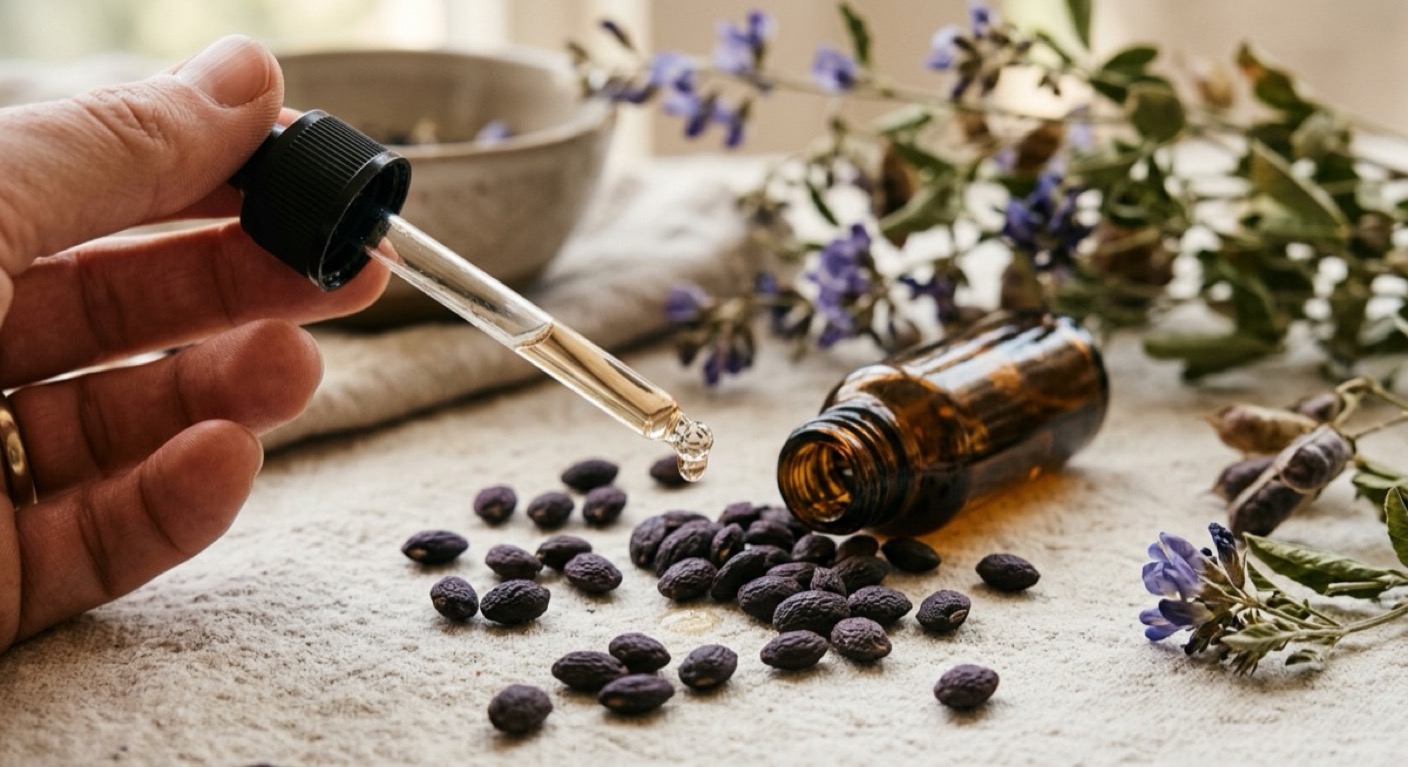
Bakuchiol is a meroterpene phenol extracted from the seeds and leaves of Psoralea corylifolia, a plant known as babchi that has been used in traditional Ayurvedic and Chinese medicine for centuries. Its structure bears no resemblance to retinoids; it is not chemically related to vitamin A. What is notable is that at the gene expression level, bakuchiol produces remarkably similar effects, activating many of the same pathways that retinol uses to remodel skin.
Gene expression studies have shown bakuchiol upregulates types I, III, and IV collagen, reduces MMP-1 (the primary collagenase involved in photoaging), and modulates retinoid receptors including RAR-beta and RAR-gamma. It achieves this through a functionally analogous mechanism without binding to the same receptors that cause retinoid-associated irritation.
What the clinical review found
The review published in the Journal of Integrative Dermatology examined 7 clinical papers directly comparing or studying bakuchiol against retinol for anti-aging outcomes. The key findings across the included trials:
Wrinkle depth and fine line counts showed comparable reductions between bakuchiol and retinol groups at 12-week endpoints. Hyperpigmentation and uneven skin tone improved in both groups at statistically similar rates. The landmark 2019 study published in the British Journal of Dermatology randomized 44 participants to 0.5% bakuchiol twice daily versus 0.5% retinol once daily and found no significant difference in wrinkle or pigmentation outcomes at 12 weeks. The bakuchiol group reported significantly less facial scaling, stinging, and dryness.
Subsequent trials confirmed the tolerability advantage. One head-to-head trial reported that over 70% of retinol users experienced some degree of facial irritation versus under 20% in the bakuchiol group, using equivalent anti-aging concentrations.
The tolerability advantage and what it means in practice
Retinol’s irritation profile has a direct clinical consequence: it limits the concentrations that can be tolerated, particularly during initial months of use. Dermatologists typically recommend a gradual titration from 0.025% up to 0.1% or higher over 6-12 months. During that period, results are limited and many patients stop before reaching therapeutic concentrations.
Bakuchiol can generally be used at effective concentrations from the outset, twice daily without the recommendation to avoid sun exposure that retinol requires. This is a practical advantage that compounds over time. A user who tolerates bakuchiol consistently for 12 months is likely to see more total improvement than one who struggles through retinol irritation and periodic breaks.
What the evidence gap looks like
The review is careful to note where bakuchiol’s evidence base is thinner than retinol’s. Retinol and tretinoin (its prescription-strength derivative) are supported by over 50 randomized controlled trials conducted over several decades. Bakuchiol’s clinical evidence at the time of the review covered approximately 20 trials. The collagen synthesis data, while consistent in direction, shows bakuchiol producing more modest increases than retinol at equivalent timepoints. Retinol at 0.1% has been shown to increase collagen production by 20-30% in biopsy studies. Bakuchiol’s quantified effect is smaller, though the functional outcomes (wrinkle measurements, photography scoring) show less divergence.
Pregnancy and sensitive populations
Topical retinoids are generally avoided during pregnancy due to teratogenicity concerns, the established risk from high-dose systemic vitamin A derivatives. While topical absorption is low, the precautionary approach has long recommended avoidance. Bakuchiol carries no known teratogenicity concerns based on its mechanism and structural profile. However, the review and dermatological guidelines are consistent in noting that large-scale pregnancy safety data remains insufficient for a definitive safety claim. For individuals who were previously using retinol and are now pregnant, bakuchiol is considered a reasonable discussion point with a healthcare provider rather than a guaranteed safe substitute.
FAQ
Q: Can bakuchiol fully replace retinol? A: Clinical trials show comparable wrinkle and pigmentation improvement, but retinol has 50+ RCTs vs bakuchiol’s roughly 20. Retinol boosts collagen production 20-30%, while bakuchiol’s effects are milder.
Q: Is it safe during pregnancy? A: Unlike retinol, bakuchiol has no teratogenicity concerns in theory. However, large-scale pregnancy safety data is still insufficient for definitive claims.
Q: What plant does bakuchiol come from? A: It’s a meroterpene phenol extracted from Psoralea corylifolia (babchi plant) seeds and leaves. Despite no structural resemblance to retinoids, it functions as a retinol analog at the gene expression level.