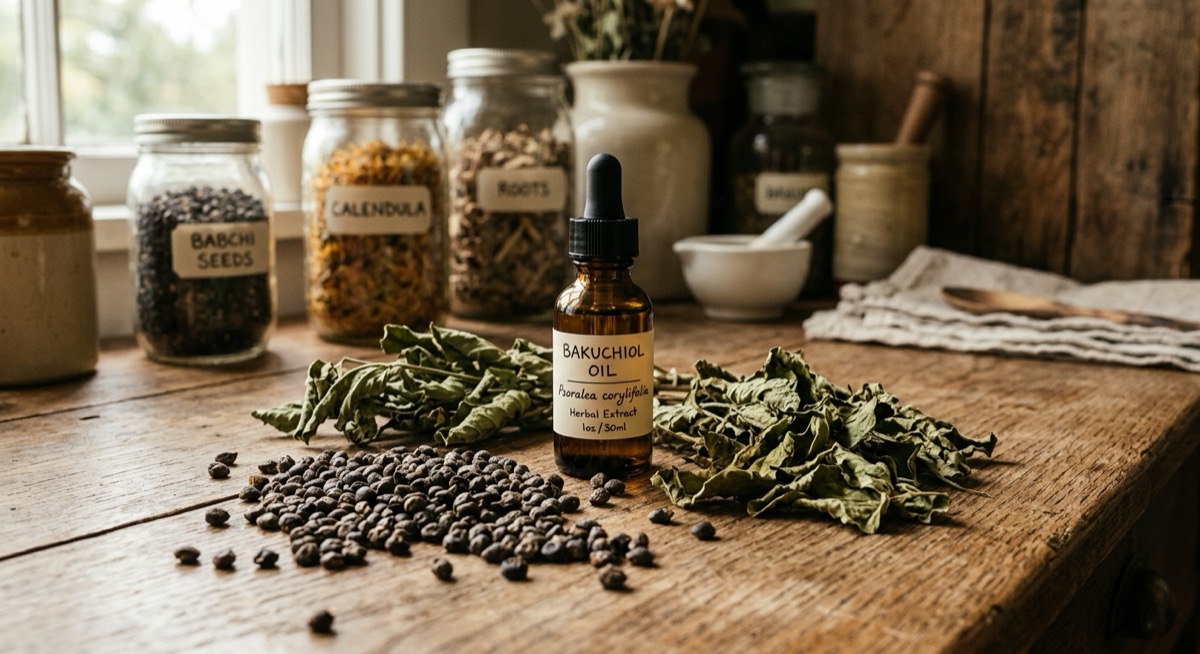
Bakuchiol 1.25% Plus Peptides Becomes The Retinol-Equivalent Option For Skin That Won't Tolerate The Real Thing
The retinol-alternative market matured through 2026 around bakuchiol-and-peptide combinations. The reference clinical data is Dhaliwal et al., British Journal of Dermatology 2019: 0.5% bakuchiol over 12 weeks matched 0.5% retinol on fine lines and pigmentation, with significantly less irritation. The current generation of serums pushes bakuchiol to 1.25% alongside peptide precursors and Centella asiatica, layered in an oil base.
The Reference Clinical Data (Dhaliwal BJD 2019)
Head-to-head:
- British Journal of Dermatology 2019
- 0.5% bakuchiol vs 0.5% retinol
- Twice daily for 12 weeks
- Fine-line and hyperpigmentation outcomes: statistically equivalent
- Side effects (dryness, peeling, erythema): significantly less with bakuchiol
Mechanistic profile (from a PMC comprehensive review):
- Stimulates dermal extracellular matrix component fibronectin, a target retinol does not directly engage
- Accelerates epidermal regeneration; supports wound healing
- Reduces some senescence markers
- Antioxidant activity
- Does not raise photosensitivity
What’s New In The 1.25% Generation
Current commercial products such as Medik8’s Bakuchiol Peptides anchor on 1.25% pure bakuchiol rather than the 0.5% clinical reference, alongside three additions.
Brightening peptide precursors: Modulate melanin synthesis pathways, layering a second pigment-improvement mechanism on top of bakuchiol’s direct effect.
Centella asiatica: Soothing and barrier-supportive; aids collagen synthesis; stabilizes the formulation for reactive skin.
Oil-base matrix: Bakuchiol is lipophilic. An oil matrix improves penetration and stability. UV-protective glass and a natural photo-stabilizer (krameria triandra root extract) prevent photodegradation.
Who Actually Benefits Over Retinol
Retinol and tretinoin work, but the first four to six weeks bring an irritation phase that knocks out many users. Bakuchiol becomes clinically interesting for three groups.
Sensitive, rosacea-prone, or flushing skin: People who can’t sustain retinoid retinization. The Dhaliwal trial showed equivalent efficacy at 0.5% for 12 weeks without measurable irritation.
Pregnancy and lactation (with caution): Oral and topical retinoids are contraindicated or cautioned during pregnancy. Bakuchiol is structurally non-retinoid, so the theoretical risk is low. Direct pregnancy/lactation clinical data are still absent. Marketing claims of pregnancy-safe use are extrapolations, not clinical evidence. Anyone pregnant should clear use with a clinician.
Morning and evening flexibility: Bakuchiol does not raise UV sensitivity. It layers with vitamin C and niacinamide. None of retinol’s evening-only and active-restriction constraints apply.
What Travels
In markets like Korea, retinol dominates, but bakuchiol-only lines have grown quickly. Three reads matter for translation.
1.25% is not proven to outperform 0.5%: The clinical reference data is at 0.5%. Higher concentration does not automatically convert to higher efficacy, and may increase irritation risk. A rational sequence is to start at 0.5%, adapt for four to eight weeks, then consider increasing.
Layering with vitamin C and niacinamide is real, but: Korean routines often run heavy on layers. Bakuchiol conflicts less with other actives, but loading too many simultaneously prevents isolating which one is working. One active at a time, four weeks of observation, holds.
‘Pregnancy-safe’ claims need scrutiny: A growing number of products foreground pregnancy use. Safety data are weak. Default to simple moisturization and sunscreen during those windows, and lean on a clinician.
Pricing: 1.25% bakuchiol-peptide blends often sit 1.5 to 3 times the cost of basic 0.5% retinol products. If the efficacy is similar, the right question is how much avoiding irritation is worth to a given user.
Clinical Implications
A market category that earned legitimacy: Five years ago, bakuchiol leaned on ‘gentle alternative’ marketing with thin data. Dhaliwal 2019 and the PMC review pulled the category onto firmer ground.
Fibronectin stimulation is a real differentiator: Bakuchiol is not just a weak retinoid. The fibronectin pathway is not directly engaged by retinol, opening combination trials (retinol plus bakuchiol) that pair complementary mechanisms.
Clinical evidence still lags formulation: A dedicated RCT for the 1.25% plus peptides plus centella stack is missing. Marketed efficacy is extrapolated from 0.5% monotherapy. The category needs a head-to-head trial at the current commercial concentration.
Bottom Line
For skin that does not tolerate retinol, for windows of pregnancy or lactation under clinical guidance, or for routines that want to layer vitamin C and niacinamide without compromise, bakuchiol now has clinical evidence behind it. The 1.25% plus peptides plus centella stack is a market evolution; the 0.5% 12-week head-to-head against retinol is the foundation it rests on.
If retinol already works, there is no clinical reason to switch. The case for bakuchiol is irritation, layering freedom, or morning use, not raw potency.