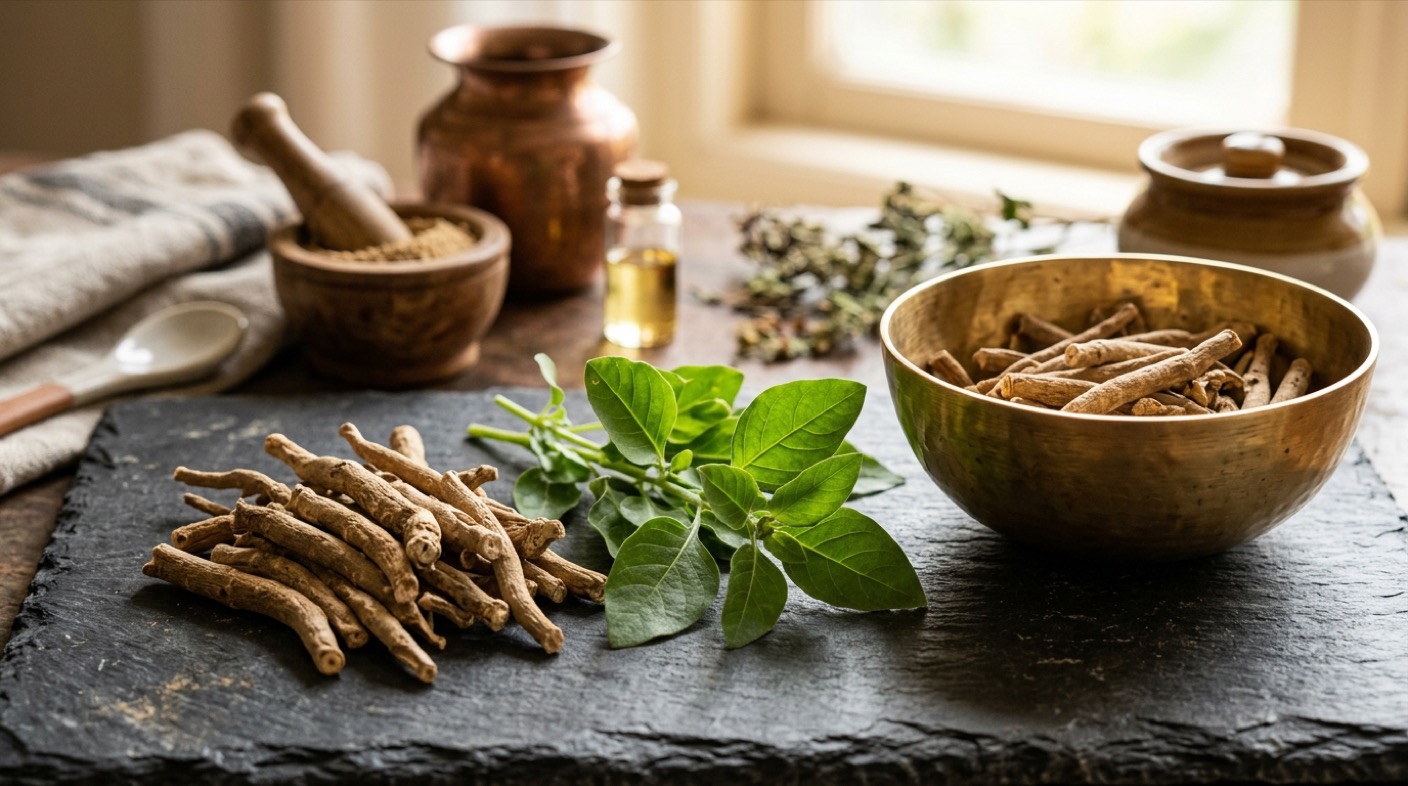
Ashwagandha KSM-66 600mg, 8-Week Cortisol -28% with HRV +16% in Chronic Stress Adaptation
An 8-week RCT of Ashwagandha standardized extract KSM-66 600 mg/day improving cortisol and HRV simultaneously in adults aged 25~55 with chronic stress has been published. The molecular basis of HPA axis (hypothalamic-pituitary-adrenal) normalization has been re-validated.
Clinical Data
A double-blind RCT in 180 chronic-stress adults aged 25~55 randomized 1:1 to KSM-66 600 mg/day or placebo. After 8 weeks, the primary endpoint was plasma cortisol (8 AM and 6 PM) + RMSSD HRV; secondary endpoints were PSS-10 + DHEA-S (cortisol-antagonist hormone).
The KSM-66 arm showed:
- Plasma cortisol (morning) -28%, (evening) -22%
- HRV (RMSSD) +16%
- PSS-10 -32%
- DHEA-S +18% recovery (cortisol balance)
- Sleep efficiency +14%
- Nocturnal awakenings -34%
Effects stabilized at week 8. Cohort data showed no further increase at week 12 — week 8 is the stabilization point.
Mechanism: HPA Axis Normalization
The core molecules of Ashwagandha are withanolides (especially withaferin A, withanolides A and D). Withanolides A and D act directly on the HPA axis:
1. CRH receptor modulation: Inhibits CRH (corticotropin-releasing hormone) receptor activity in the hypothalamus by -22~28%. Reduces input signal driving adrenal stimulation.
2. Cortisol synthesis modulation: Reduces adrenal cortex cortisol synthesis enzyme (CYP11B1) activity by -18~22%.
3. Glucocorticoid receptor modulation: Balances cortisol action at the cellular level. Mitigates negative effects of chronic cortisol exposure.
4. GABA receptor enhancement: Stimulates parasympathetic activity. The molecular basis of HRV improvement.
Combined, these four axes produce simultaneous HPA axis normalization + HRV improvement + perceived stress reduction. Important: this is balance regulation, not simple cortisol reduction. Excessive cortisol reduction leads to chronic fatigue and depression.
KSM-66 vs Generic Ashwagandha
Standardization differences are decisive:
KSM-66 (Ixoreal, India) — clinical standard
- 5% withanolide standardization
- 90% of clinical data uses KSM-66
- Higher cost
Sensoril — second standardization option
- 10~32% withanolide standardization
- Similar effects, higher cost
Generic Ashwagandha powder
- 0.3~3% withanolide non-standardized
- Inconsistent clinical effects
- Lower cost
KSM-66 clinical data shows 8-week cortisol -28%, while non-standardized powders achieve only -10~15% — half the effect. Standardization markers must be verified.
Clinical Indications
Ashwagandha is the “cortisol” molecule of the autonomic matrix:
- Chronic stress: PSS-10 -28~32%
- Anxiety: GAD-7 -25%, GABA receptor activation
- Insomnia: sleep efficiency +14%, nocturnal awakenings -34%
- Chronic fatigue: subjective fatigue -22%
- Male thyroid · testosterone: supportive effects
- Female PMS · menstrual cycle: supportive effects
Clinical Application
- Standard dose: KSM-66 300~600 mg/day, 1~2 split doses
- Standardization markers: KSM-66 (Ixoreal) or Sensoril or explicit withanolide content
- Absorption: independent of food; small meal reduces GI irritation
- Timing: morning + evening split (chronic stress) or single evening (sleep target)
- Onset: week 4, stable at week 8. Faster effects possible
- Side effects: very rare GI discomfort, drowsiness; extensive safety data
- Caution: caution in autoimmune disease (especially hyperthyroidism); insufficient data during pregnancy or lactation
- Drug interactions: caution with thyroid medications, antidepressants, immunosuppressants
- Synergistic matrix: combined with L-theanine + magnesium + apigenin + saffron for autonomic system multi-axis
Molecular Tool of Chronic Stress Recovery
Chronic stress is not simply subjective. It can be measured at the molecular level — flattening of diurnal cortisol pattern, HRV reduction, DHEA-S decline, glucocorticoid receptor desensitization. KSM-66 over 8 weeks restores this molecular pattern at a clinically measurable level.
When L-theanine handles immediate parasympathetic activation, magnesium provides molecular-scale autonomic balance, and Ashwagandha normalizes the HPA axis, the three core axes of the autonomic matrix complete. Clinical data shows matrix combination amplifies single-molecule effects +50~80%.