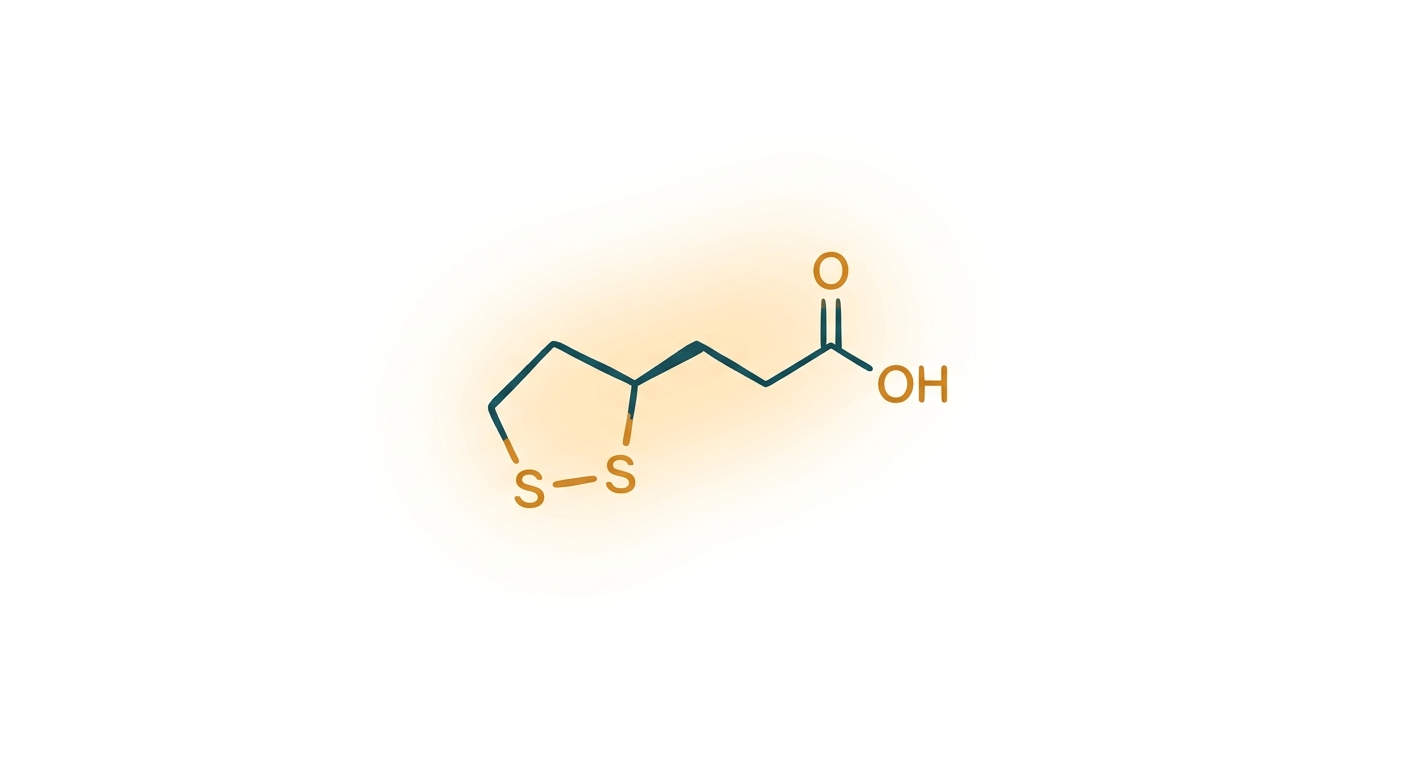
Alpha-Lipoic Acid
What is alpha-lipoic acid? Alpha-lipoic acid (α-lipoic acid, ALA, thioctic acid). Short-chain fatty acid synthesizable by the body from methionine. Functions as cofactor for mitochondrial enzymes (pyruvate dehydrogenase etc.). Dual antioxidant property working in both water and lipids. 70+ years of use as diabetic neuropathy adjunct. R-form is natural active, 600 mg/day clinical standard dose. Mechanisms include glutathione regeneration, microcirculation improvement, and some insulin sensitivity support.
What is alpha-lipoic acid
Alpha-lipoic acid (ALA) is a short-chain fatty acid naturally synthesized in all body cells. Functions as cofactor for mitochondrial enzymes, core to energy metabolism.
Discovery and use:
1950s isolation: Isolated from yeast at the U.S. Department of Agriculture.
1960s clinical: Started prescription use for diabetic neuropathy in Germany.
Modern: Two categories — prescription drug (Germany etc.) and supplement (US etc.).
70+ years of use: One of the longest clinical data records.
Forms (R vs S)
R-form (R-alpha-lipoic acid, R-ALA): Natural form. The form the body synthesizes. More active. Absorption and effect superiority.
S-form: Synthesis byproduct. Weak activity.
Racemic ALA (R+S 50:50 mix): Most common supplement form. Inexpensive. Most clinical data.
R-ALA alone: Higher cost. Absorption advantage.
Na-RALA (sodium R-lipoate): Improved stability. Most stable R-form.
Label verification: “alpha-lipoic acid” only is racemic. Look for R-ALA labeling.
Mechanism
Dual antioxidant: Works in both water (plasma) and lipids (cell membranes). Overcomes other antioxidant limits.
Glutathione regeneration: Strengthens cellular glutathione system. Aids antioxidant network.
Vitamin C, E regeneration: Aids recycling of other antioxidant systems.
Mitochondrial protection: Energy metabolism as enzyme cofactor. Stabilizes mitochondrial membranes.
Microcirculation improvement: Nerve microvascular blood flow.
Insulin sensitivity improvement: Stimulates GLUT4 translocation. Aids glucose uptake.
Inflammation reduction: Some NF-κB inhibition.
Metal chelation: Aids some heavy metal binding.
Clinical data
Diabetic neuropathy (strongest data): 9-RCT meta-analysis showed Total Symptom Score (TSS) -2.26 meaningful reduction. Nerve impairment scores and disability scores also reduced. 600 mg/day standard.
Metabolic syndrome: Some trials improve insulin resistance, lipids.
Non-alcoholic fatty liver (NAFLD): Some antioxidant adjunct data.
Alzheimer’s/MCI: Some data, weak.
Diabetic retinopathy: Some trials.
Menopause hormone adjunct: Some data.
Male infertility: Some sperm motility data.
Weight loss: Small effects in some trials. Not magic.
Dietary sources
Difficult to reach clinical doses dietarily but naturally contained:
Spinach (raw): ~0.2 mg per 100 g.
Broccoli: ~0.1 mg per 100 g.
Tomato: ~0.04 mg per 100 g.
Beef liver: Most abundant. ~0.7~10 mg per 100 g.
Beef kidney: Rich.
Red meat: 0.2~0.5 mg per 100 g.
Difficult to reach clinical dose (600 mg) dietarily. Supplements efficient.
Dose and timing
Standard neuropathy: Racemic ALA 600 mg/day.
R-ALA alone: 300 mg/day (equivalent to racemic 600 mg).
Single oral: 600 mg once.
Split oral: 200~300 mg 2~3 times.
IV: Physician facility. 600 mg.
Timing: Empty stomach (30 min before meals or 2~3 hours after). Absorption advantage.
Duration: Effect assessment at 6~12 weeks. Chronic use common.
Who fits
Type 1, 2 diabetes neuropathy: First-line adjunct. Physician evaluation.
Pre-diabetes + peripheral nerve symptoms: Adjunct option.
Metabolic syndrome + oxidative stress: Antioxidant adjunct.
Alcoholic neuropathy: With alcohol avoidance.
Menopause hormone variability: Some data.
Mitochondrial burden targeting: Chronic fatigue, slowed exercise recovery.
Who should be careful
Hypoglycemia risk: Blood glucose monitoring with diabetes drugs (insulin, metformin).
Hypothyroidism: Possible thyroid hormone absorption effects. Time-separate.
Thiamine (B1) deficiency: ALA competes with thiamine metabolism. Vitamin B1 supplementation recommended. Especially in alcohol abuse populations.
Pregnancy/breastfeeding: Limited data.
Drug interactions: Caution with some chemotherapy, anticoagulants.
GI sensitivity: Take split with meals or in absorption-enhanced forms.
Allergies: Uncommon but possible.
Comparison to other antioxidants
Vitamin C: Water-soluble. Wide-range antioxidant.
Vitamin E: Lipid-soluble. Membrane antioxidant.
Glutathione: Master cellular antioxidant.
CoQ10: Mitochondrial antioxidant. Cardiovascular, cognition.
Alpha-lipoic acid: Dual antioxidant + glutathione regeneration + mitochondrial support.
Astaxanthin: Strong antioxidant. Skin, eyes.
ALA targets multiple. Synergy with other antioxidants.
Daily guide
Step 1 — diagnosis: Physician evaluation. Diagnosis of neuropathy, diabetes, metabolic syndrome.
Step 2 — foundation: Glucose management, exercise, weight management, alcohol avoidance.
Step 3 — start ALA: 600 mg/day empty stomach. Racemic or R-ALA 300 mg.
Step 4 — matrix: Vitamin B1 100 mg, B12 1,000 μg, B6 25 mg, omega-3 1~2 g.
Step 5 — assessment: Nerve symptoms, blood glucose, lipid assessment after 6~12 weeks.
Step 6 — monitoring: Thyroid function, blood glucose, drug interactions.
Alpha-lipoic acid is a well-validated antioxidant used 70+ years. First-line adjunct option for diabetic neuropathy. Physician evaluation and monitoring essential.
FAQ
Q. Racemic ALA vs R-ALA, which to choose? A. Most clinical data is racemic ALA. R-ALA has absorption advantage but cost difference. Racemic 600 mg/day is standard clinical.
Q. Does ALA help with weight loss? A. Small effects in some trials. Insulin sensitivity improvement and oxidative stress reduction are the mechanism. Not a magic diet. Foundation (diet, exercise) priority.
Q. Does it need daily intake for effect? A. Neuropathy targeting requires consistent daily 6~12+ weeks. Works through cumulative effect.
Q. Can it be combined with other supplements? A. Safe with B-vitamin matrix, omega-3. Time-separate from thyroid medications. Caution with anticoagulants.
Q. What are side effects? A. Generally mild GI discomfort. Rare headache, skin rash. Hypoglycemia (with diabetes drugs).
Q. Can it be used without clinical neuropathy diagnosis? A. Possible as antioxidant targeting. But without clinical indication, prioritize diet/exercise. Physician evaluation recommended.